
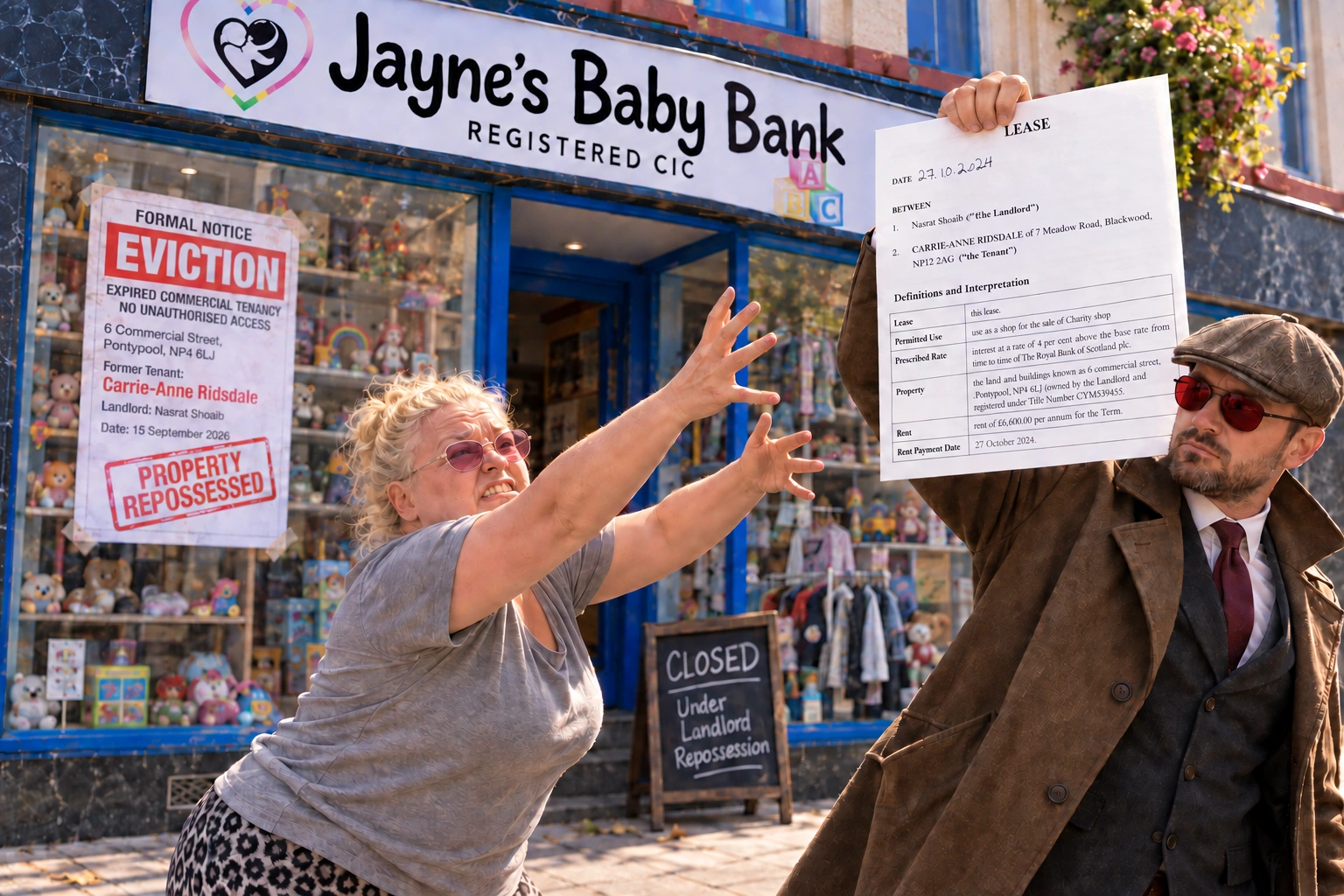
Since the shutters came down on 6 Commercial Street, Jayne’s Baby Bank has posted four times to explain why none of it counts. The rent did not have to be paid. The roof was not her problem. She is “leaseless and footloose”. A landlord can type anything he likes on a Word document. This site has now seen the lease — all nine pages of it. It answers every one of those claims. And it names the tenant as CARRIE-ANNE RIDSDALE.
The short version
If you read nothing else, read this.
- Jayne’s Baby Bank rented a shop at 6 Commercial Street, Pontypool. The rent was £550 a month.
- The lease lasted one year. It started on 27 October 2024. It ran out on 26 October 2025.
- She stayed for another 324 days after it ran out. She had no right to be there.
- She stopped paying the rent. She has said so herself: “we stopped paying”. We are informed that at least four months are still owed — at £550 a month, that is at least £2,200.
- She has given several different reasons for not paying. One of them was that the landlord had joined a Facebook group.
- She says she did not have to pay rent, because the building was unsafe. Her lease does not say that anywhere.
- She says fixing the roof was not her job. Her lease says it was. Repairs were the tenant’s job, not the landlord’s.
- Her lease also says that if the building became unsafe to use, the lease ended straight away. So either she owed the rent, or she had no lease at all. Either way, she had to leave.
- The lease says the building was let for “a shop for the sale of Charity shop”. Those are the document’s own words.
- Jayne’s Baby Bank is not a charity. It has never been registered with the Charity Commission. It became a community interest company — a type of limited company, not a charity — in November 2025, after this lease had already run out.
- The lease only allowed the building to be used as a shop that sells things. It was used as a store instead, and she announced plans to open a pet cafe in it. Her lease banned keeping animals there.
- The rooms above the shop were a separate letting. She called them P3, and she never signed a lease for them. She said so herself, on camera, more than once. She filled them with donated stock anyway.
- In September 2026 she told people she did not have to pay the rent on P3. You cannot stop paying rent on a shop you never rented.
- The lease names the tenant as Carrie-Anne Ridsdale — a name she has publicly denied is hers. She signed it herself, in front of a witness.
The rest of this report shows you the pages. Some legal words are explained in plain English at the end.
The document
This site has seen the tenancy agreement for 6 Commercial Street, Pontypool in full. Not an extract, not a summary, not a photograph of a page through a shop window. All nine pages, front to back, including the schedules and the execution page.
It is a lease, executed as a deed, dated by hand 27 October 2024. The landlord named in it is Nasrat Shoaib — the same name printed on the Formal Notice taped to the window of the shop on 15 September 2026. The tenant named in it is not Jayne’s Baby Bank, and it is not a company.
Three years of this argument have been assertion against assertion. A lease is a different kind of object: written before any of it, and unchanged by who is holding it.
So here is the contractual position, directly.
Whose name is on it
Page one. A handwritten date, and two parties.
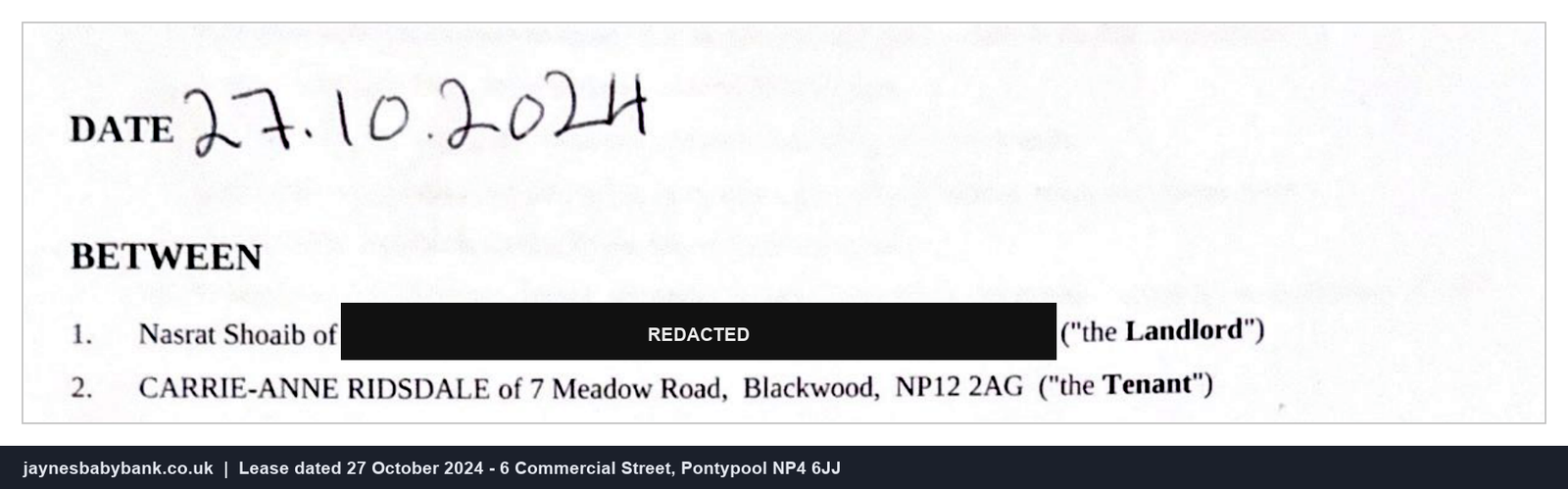
Note the address beside her name: 7 Meadow Road, Blackwood, NP12 2AG.
That is the same address that appears on the County Court Judgment entered at the Civil National Business Centre on 27 January 2026, case number M3DP9X7A, for £277, unsatisfied, against MISS CARRIE-ANNE RIDSDALE. We published that judgment on 15 May.
Same name. Same house. One is a court record, the other a private lease — created fifteen months apart, by different people, for unrelated purposes.
The public position has always been that Carrie-Anne Ridsdale is somebody else. When the £7,141 judgment surfaced against Ceri-Ann Ridsdale t/as Jayne’s Baby Bank, the response was that it was “not even my name”, and that there were no legal documents connected to the operation at all.
The signature
A credit file can be called an error. A court register can be called somebody else’s paperwork. A landlord’s notice in a window can be called, as it was called last week, something “they have typed up on a word document”.
This is page nine.
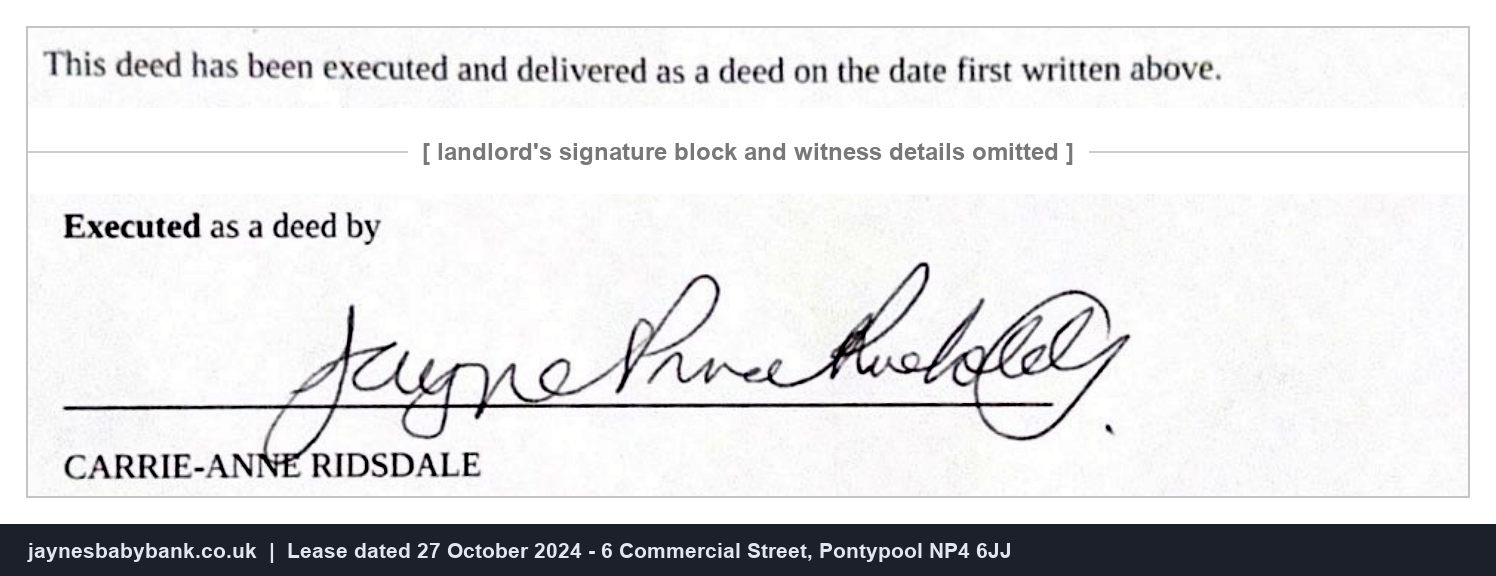
Not a database entry. Not a screenshot. A deed — the most formal instrument in property law — signed by hand, in front of a named witness who wrote down his own address and occupation, by the person the document calls CARRIE-ANNE RIDSDALE.
The signature itself begins, quite legibly, Jayne.
Either Carrie-Anne Ridsdale signed this lease, or Jayne’s Baby Bank spent nearly two years trading out of a building leased to a woman it says it has never heard of. There is no third answer.
£550 a month, on the 27th, by standing order
The definitions on page one set the terms.
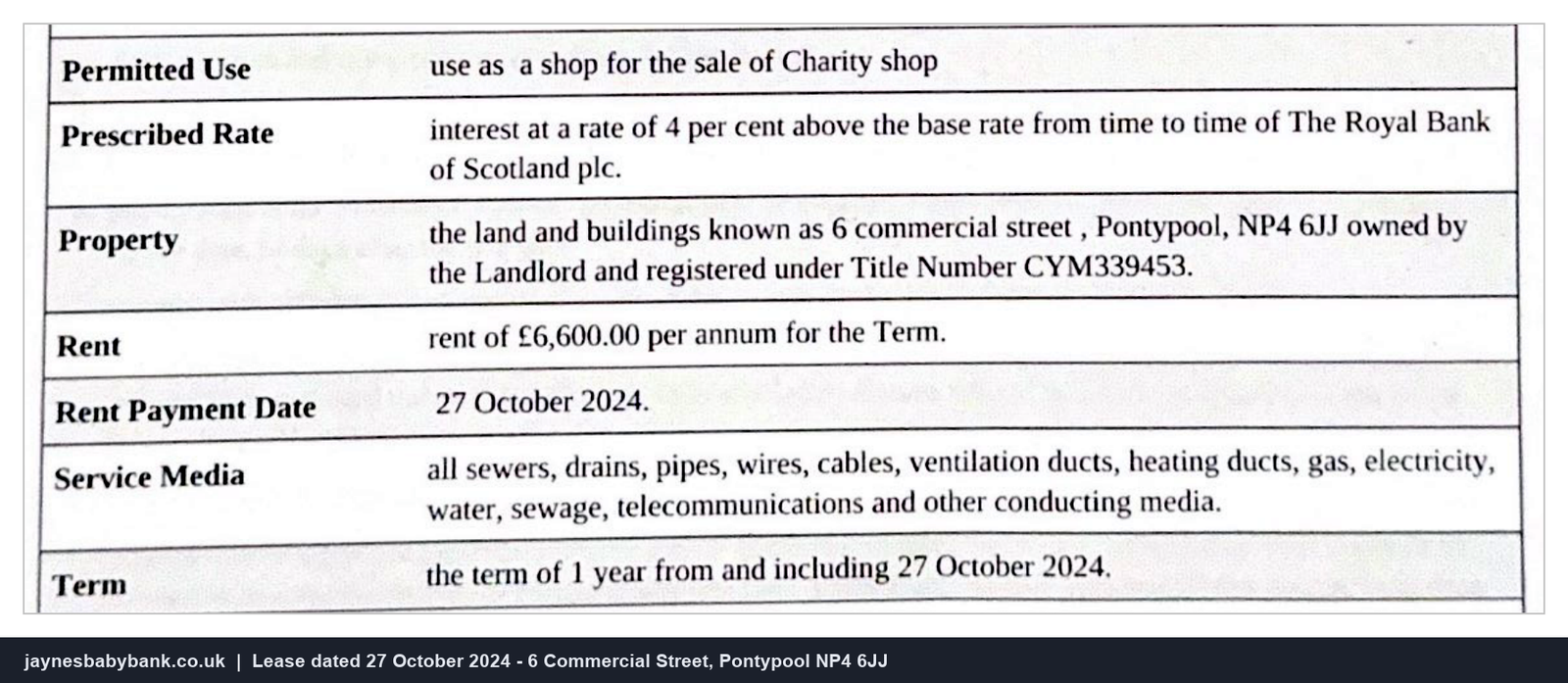
- Permitted Use: “use as a shop for the sale of Charity shop”
- Property: “the land and buildings known as 6 commercial street, Pontypool, NP4 6JJ” — registered under Title Number CYM339453
- Rent: “£6,600.00 per annum for the Term”
- Term: “1 year from and including 27 October 2024”
£6,600 a year is £550 a month. Clause 5(a) sets out how and when:
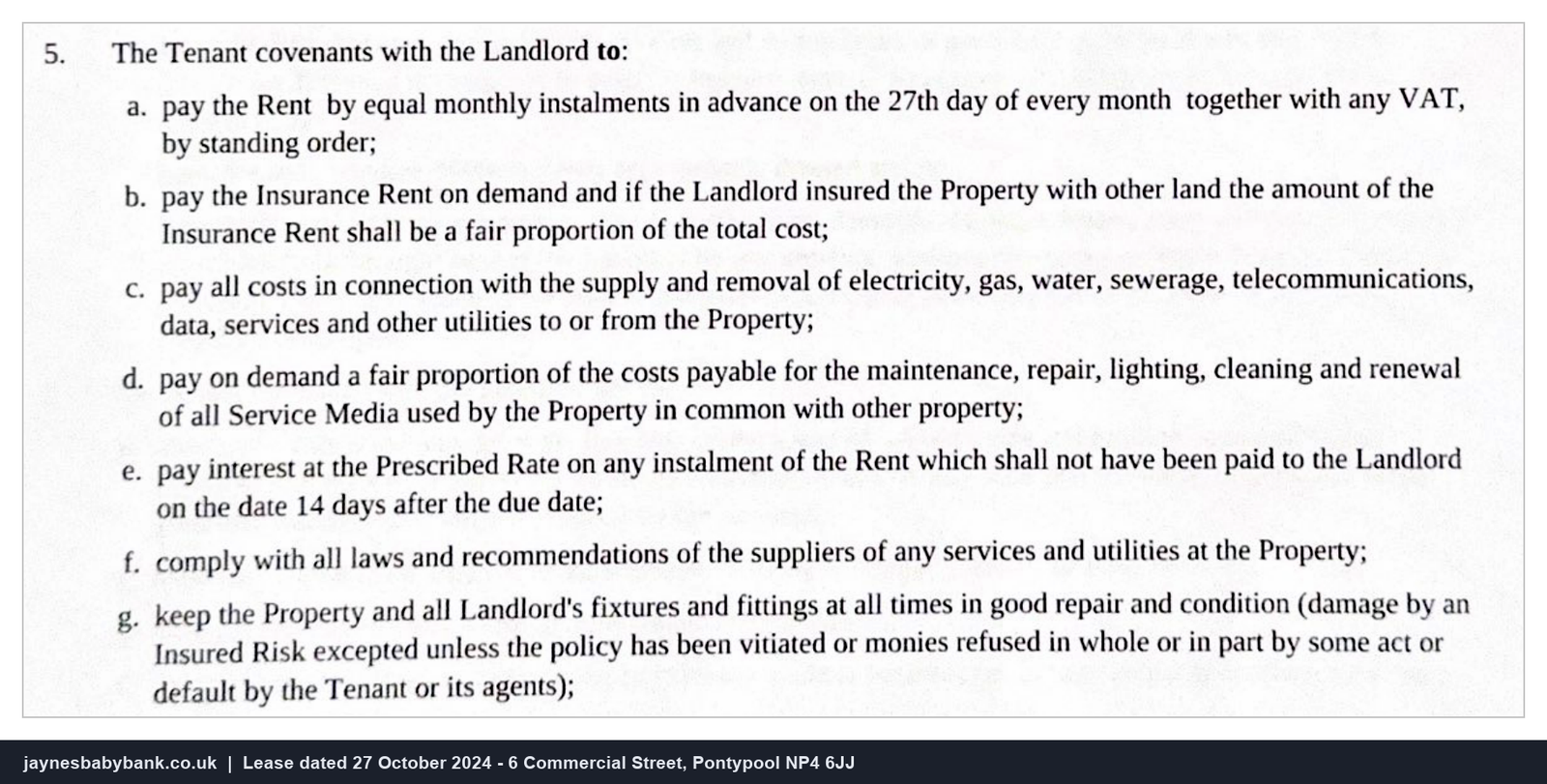
a. pay the Rent by equal monthly instalments in advance on the 27th day of every month together with any VAT, by standing order;
Now set that beside what Jayne’s Baby Bank told its followers on 16 September:
“P2/3 landlord wanted £550 for down stairs and £900 upstairs. How much would you pay to rent these buildings.”
Jaynesbabybank Registered – cic, 16 September 2026
The landlord did not “want” £550. It was the rent she had contracted to pay, monthly in advance, by standing order, under a deed she signed. She quoted her own lease back at the public as an outrageous suggestion somebody had made to her.
It has not been paid. We are informed by sources we consider reliable that at least four months’ rent remains outstanding. At £550 a month that is £2,200, and “at least” is doing a good deal of work in that sentence. Under clause 5(e), unpaid instalments also carry interest at 4% above the Royal Bank of Scotland base rate from fourteen days after the due date.
We do not have to rely on anyone’s word for the central fact. She has said it herself.
“We stopped paying”
The 16 September post that opens with the rent argument closes by conceding the premise of it:
“If a landlord wanted to pursue us civilly for any non payment of rent they could but the we would state why we stopped paying due to the leaks, damp mould and ceilings and walls falling apart.”
Jaynesbabybank Registered – cic, 16 September 2026
There is no ambiguity in that sentence. The rent stopped. What has moved, repeatedly, is the reason.
| Date | Why the rent was not being paid |
|---|---|
| 28 Jan 2026 | Price. “I’ve said to the landlords, no I’m not paying them more than £400… don’t even try and say to me this shop is worth £800. Because it isn’t anymore.” |
| 12 Jun 2026 | Condition. “Haters keep saying we don’t pay rent. Would you pay it when you have to come in a pick up the ceiling off the floor on a daily basis.” |
| 15 Jun 2026 | The roof. “The roof is leaking, get up on the roof and fix it. I’m not doing it and I’m not paying for it.“ |
| 29 Jun 2026 | A rent increase. “I’m not paying more rent because the baby bank is not paying for the work… if you’re going to put the rent up, I’m not paying it.” |
| 11 Jul 2026 | A Facebook group. “I’m not paying any rent to a landlord who’s part of that group sorry on principle.” |
| 18 Jul 2026 | The same. “I pay my rent. I won’t pay my rent if any of the landlords are in this group. And I think that’s fair enough.” |
| 16 Sep 2026 | Prohibition notices. “we do not have to pay any rent… once a Health and Safety Prohibition is in place.” |
Note what happens in July. The building has not changed. The roof has not changed. The reason given for withholding rent is that the landlord was said to be a member of a Facebook group — and that this made non-payment a matter of principle.
“I’m not paying any rent to a landlord who’s part of that group sorry on principle.”
Jaynesbabybank Registered – cic, 11 July 2026
There is no clause in this lease, or in any lease, that suspends rent because a landlord has joined a group on the internet. And it is not consistent with the account given two months later, in which the rent stopped because of leaks, damp and falling ceilings.
“Use as a shop for the sale of Charity shop”
One line in that definitions table does more work than any other. The lease does not let the building for any purpose the tenant fancies. It lets it for one:
Permitted Use — use as a shop for the sale of Charity shop
The drafting is clumsy; the effect is not. Clause 5(i) makes it binding: the Tenant must “only use the Property for the Permitted Use“. A shop, for the sale of goods. Clause 5(s) requires her to keep it “open for trading” during hours usual for the area, and 5(t) to keep the shop window “appropriately dressed and lit”.
A working high street shop that opens its doors and sells things. Three problems follow.
It was used as a store, not a shop
Within months of signing, by her own account, 6 Commercial Street was not trading. It was full.
17 June 2025: “phase two… is absolutely full of donations because everybody is so kind and generous.”
28 July 2025: “we’re currently excavating P2 of all the donations.”
2 August 2025: “I want to get P2 open next week. I think we need a warehouse now… It’s just going to get filled up. We need an actual warehouse with industrial racking.”
15 February 2026: “if we expand to P3, we’re just going to fill up P3, ain’t we? So we need a warehouse quick.”
“Get P2 open next week” is an admission that P2 was shut. “Excavating” is not a word anyone uses about a shop floor. And the landlord’s account of what he found when he took the building back is the same picture from the other side: the premises had “effectively been filled to capacity and there was very little usable space remaining“.
What she said she needed, repeatedly, was a warehouse. That is precisely what clause 5(i) did not allow this building to become.
It was announced as a pet cafe
Under four months after signing a lease restricted to use as a shop, this was posted:
“Pontypool won’t be too far behind them – opening our pet cafe as soon as its a bit warmer… PONTYPOOL SUPERSTORE CAFE AND PET CAFE PENDING.“
Jaynesbabybank Registered – cic, 16 February 2025
It was not a passing idea. In May 2025 the dog policy was “No dogs unless it’s at our pet cafe.” And in June 2025 she identified exactly which unit it was:
“The only time we have dogs in the shop is would be when we’ve opened our pet cafe… phase two which is the pet cafe is absolutely full of donations.”
Jaynesbabybank Registered – cic, 17 June 2025
Phase two is 6 Commercial Street. The lease on 6 Commercial Street says this, at clause 6(e):
6. The Tenant covenants with the Landlord not to:
e. keep any animals at the Property or to hold any sales by auction;
A cafe is not a shop for the sale of goods, so the plan breached clause 5(i). A cafe for pets breached 6(e) as well. Both had been in her contract since the day she signed it.
And there was no charity
Look again at what the building was let for. Not “a shop”. Not “retail”. The document says:
use as a shop for the sale of Charity shop
That word is in the lease because a charity shop is what the premises were taken for. It is the use the landlord let, and it is the use the tenant agreed to be bound to.
There was no charity. Jayne’s Baby Bank is not a registered charity, and was not one on 27 October 2024. It has never appeared on the Charity Commission register. An application to register was formally refused in August 2023 — fourteen months before this lease was signed — and no application has been made since.
Nor was there a company. Jaynesbabybank Registered CIC was incorporated at Companies House on 7 November 2025, company number 16838920 — more than a year after the lease was signed, and twelve days after the term had already expired. A community interest company is a limited company. It is not a charity and does not become one.
The word “charity” has nonetheless run through this operation from the beginning. Our records of the trademark register show a mark filed in May 2023 as “JAYNE’S BABY BANK & CHARITY SHOP”. The shops were run as charity shops, described as charity shops, and taken on — as this lease records — as a charity shop. Donations were given by the public on that basis.
A community interest company is a limited company that undertakes to use its assets for community benefit. It is not a charity: no Charity Commission oversight, no trustees, no charitable tax reliefs. The two are routinely confused, and the difference matters to anyone deciding where to leave a bag of baby clothes.
On the day this lease was signed there was no charity, no company, and no registration of any kind. There was one individual, at a house in Blackwood, signing a deed for a charity shop.
“We do not have to pay any rent”
This is the claim everything else rests on:
“we do not have to pay any rent for p1/p2/p3 or any shop/space once a Health and Safety Prohibition is in place as the shops have been deemed unfit for rent/use… Landlords may say we have not paid the rent but legally they have been told it is a criminal offence for them to charge any tenant rent once the prohibition is in place.“
Jaynesbabybank Registered – cic, 16 September 2026
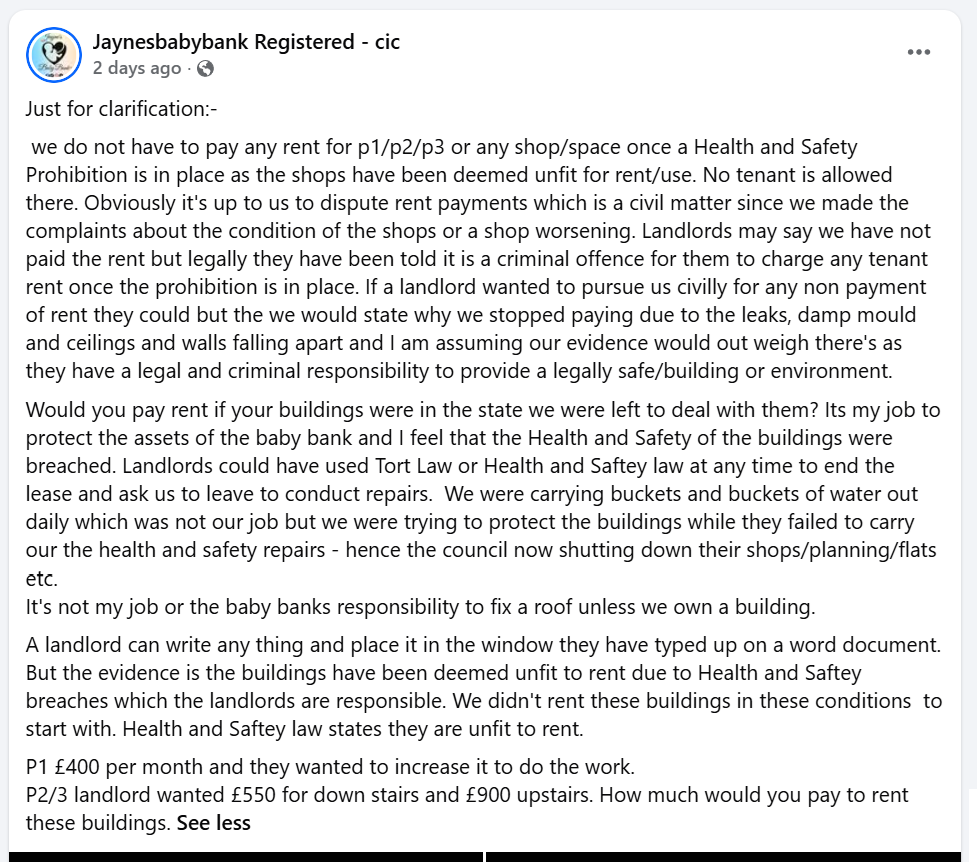
Four problems, each fatal.
1. The term had already expired before any of it
The Term was one year from and including 27 October 2024. It ran out on 26 October 2025. The fire prohibition came in March 2026. The environmental health prohibition on the neighbouring unit came in July 2026. Health and Safety attended Commercial Street on 15 September 2026.
Every prohibition in this argument post-dates the end of the lease by months. You cannot invoke a notice from 2026 to excuse rent that fell due in 2025.
2. There is no such criminal offence, and none has ever been named
A Prohibition Notice under section 22 of the Health and Safety at Work etc. Act 1974 does one thing: it directs that a specified activity must not be carried on until remedied. It is served on the person controlling that activity. It does not cancel a lease, it does not suspend a contractual rent obligation, and it creates no offence of “charging rent”.
The offence under the Act is contravening the notice — worth holding on to, because two days later the same page volunteered who the notices had been served on:
“any fire prohibition on Pontypool shop or Health and safety prohibitions in our name are now void to us…”
Jaynesbabybank Registered – cic, 18 September 2026
In our name. The whole rent argument depends on the prohibitions being evidence of the landlord’s failure. She has confirmed they were served on her.
3. The repairs were her job, not the landlord’s
Here is the entirety of what the landlord promised to do. It is two sub-clauses long.
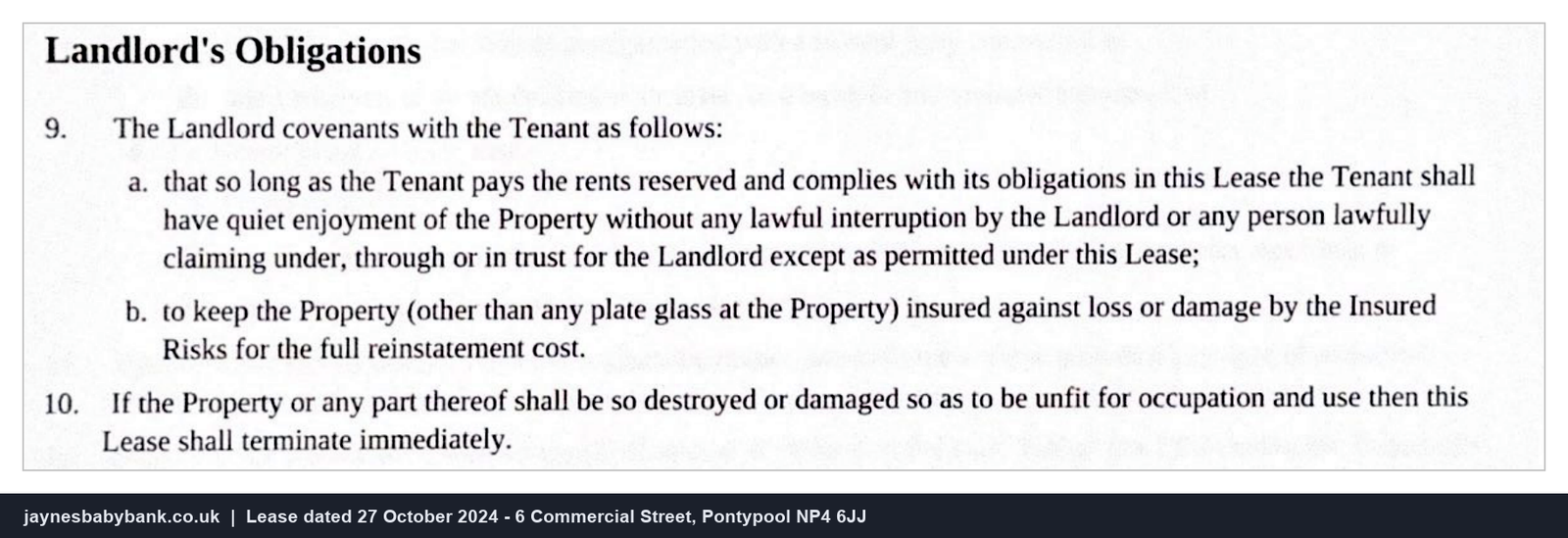
Quiet enjoyment, and insurance. That is the list. There is no obligation to repair the structure, the roof, the walls or the ceilings, because on this lease that obligation sits with the tenant — clause 5(g), on the page above:
g. keep the Property and all Landlord’s fixtures and fittings at all times in good repair and condition (damage by an Insured Risk excepted unless the policy has been vitiated or monies refused in whole or in part by some act or default by the Tenant or its agents);
“The Property” is defined as the land and buildings. Not the shopfront. Not the fixtures. The buildings. A promise to keep the land and buildings in good repair, with nothing in the lease cutting it down to the inside or to the non-structural parts, is a promise that covers the structure — and a roof is structure.
There is one genuine limit on that, and it is only fair to set it out. The words in brackets except damage caused by an Insured Risk — fire, and whatever else the landlord thought prudent to insure against. Damage of that kind is not hers to repair; it is his to insure and reinstate under clause 9(b). Nobody can say from these nine pages alone whether a particular defect at 6 Commercial Street fell inside that exception or outside it, and we are not going to pretend otherwise.
But that is a narrow, fact-specific exception, and it is not the argument that was made. The argument that was made was categorical.
So when the post says:
“It’s not my job or the baby banks responsibility to fix a roof unless we own a building.”
— that is a general rule, and it is the opposite of the one she signed. Not “this particular damage was insured”, which might have been arguable, but a flat claim that repairs are never a tenant’s responsibility. On this lease they were hers, taken on in writing on 27 October 2024 — along with decorating inside and out (5(j)), replacing the floor coverings before the end of the Term (5(k)), and keeping the drains clear (5(h)).
This is an ordinary full repairing and insuring lease — the standard form for a small unit on a Welsh high street, in nine pages of plain English. Whether anybody read it before signing is not the landlord’s problem, and it is not the public’s.
The same post anticipates that objection and tries to head it off:
“We didn’t rent these buildings in these conditions to start with.”
That is precisely what a full repairing lease is for. An obligation to keep premises in repair has long been understood to include putting them into repair first — otherwise a tenant could take on a wreck, do nothing, and hand back a wreck. A tenant who wants to be held only to the day-one condition attaches a schedule of condition, or negotiates a landlord repairing covenant. Neither appears in these nine pages. Clause 20 does:
20. The Landlord and the Tenant acknowledge that entering into this Lease it does not rely on any representation or warranty given by the other.
A non-reliance clause. She agreed, in writing, that she was not relying on anything she had been told about the building. And clause 5(i) spells out that nothing in the lease warrants that the premises can lawfully be used for the Permitted Use at all. The condition of the building on day one was her risk, by agreement, from the day she signed.
Note also the opening words of 9(a). Quiet enjoyment is promised “so long as the Tenant pays the rents reserved and complies with its obligations in this Lease”. The one protection a tenant has against a landlord walking in is conditional on paying the rent.
4. And if the building really was unfit, the lease ended by itself
This is the part that turns the argument inside out. Clause 10, immediately under the landlord’s obligations:
10. If the Property or any part thereof shall be so destroyed or damaged so as to be unfit for occupation and use then this Lease shall terminate immediately.
Read that against the claim that the shops “have been deemed unfit for rent/use”.
The argument was always meant to produce a rent-free shop. It cannot. On her own lease, “unfit for occupation and use” is not a rent holiday — it is a termination trigger. If the premises were unfit, the lease ended on the day they became unfit, and she was trading from a building she had no tenancy in whatsoever. If they were not unfit, the rent was due.
Both roads lead to the same place. Either the rent was owed, or there was no lease. The one outcome the contract does not allow is a shop you occupy for free.
“I’m now leaseless and footloose and fancy free”
On 17 September, this was posted under the heading “Just a quick update and to avoid gossip”:
“Unfortunately because of the haters constant reporting of the building they have now been served with notice to commence the works… All the haters have done is cause massive amounts of stress and anxiety and financial pressure for two landlords that also run small businesses in the middle of an economic crisis. We were always looking to expand anyway. High streets are dead – makes no difference to me because I want off the high streets. I’m now leaseless and footloose and fancy free to do what I like.“
Jaynesbabybank Registered – cic, 17 September 2026
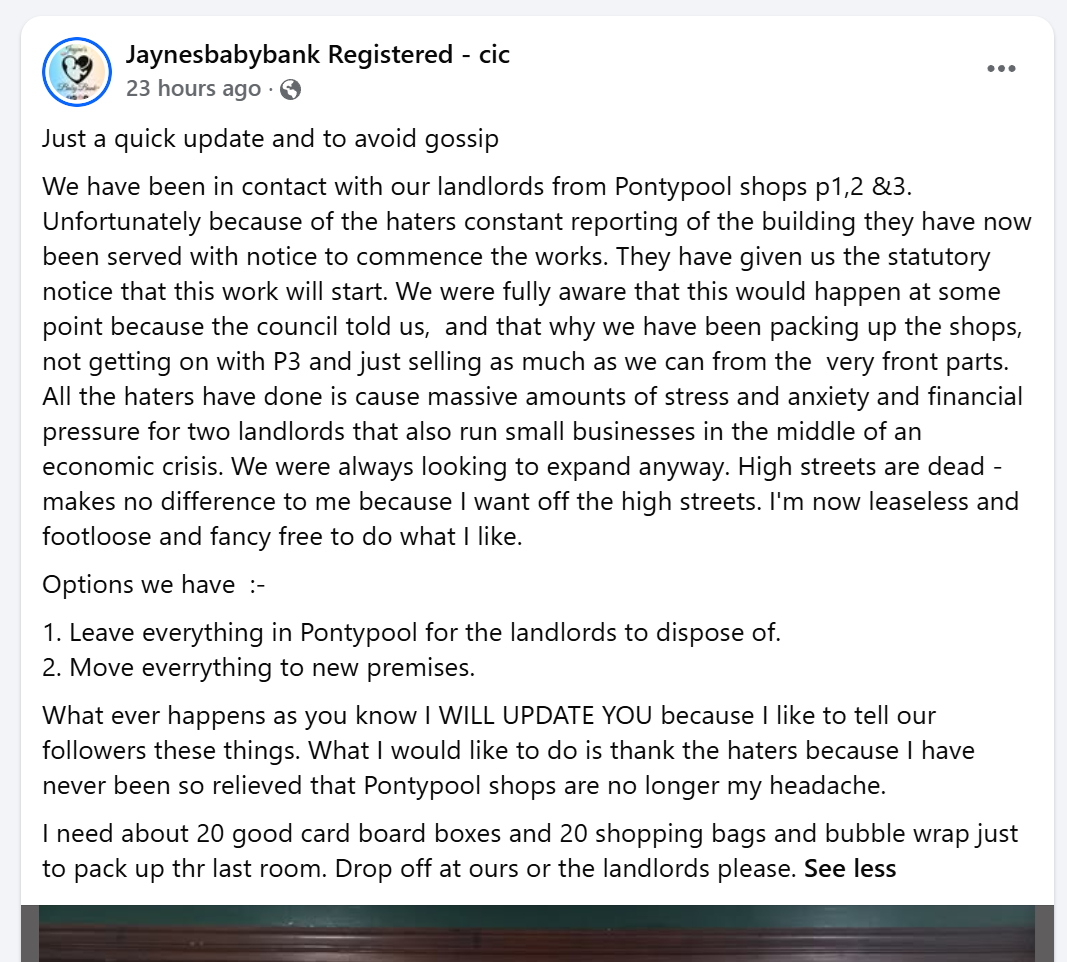
Two things in that post are worth holding up against the landlord’s account.
The first is “We have been in contact with our landlords” — a picture of an ongoing, managed relationship, in which notice has just been served on them and everyone is getting on with it. Here is the same relationship in the landlord’s own account. He dates the first breach to January 2025:
… Since then it became chasing game to get hold of her, until now.
… Although numerous times we tried to resolve the issue with offering to help her in setting up the shop for her charity business. She was never available. Subsequently we served her notice of eviction multiple times.
Nasrat Shoaib, landlord, in correspondence seen by this site
Twenty months of chasing. Multiple eviction notices. Repeated offers of help, unanswered. That is not a landlord who has just been served with something; it is a landlord who had been trying to reach his tenant since January 2025.
The second is the sympathy. The post grieves for the “massive amounts of stress and anxiety and financial pressure for two landlords that also run small businesses in the middle of an economic crisis” — and attributes that financial pressure to the people reporting the building.
One of those two landlords had not been paid rent by the author of the post for at least four months — a decision she announced herself, and at one point attributed to that landlord’s membership of a Facebook group.
As for the headline claim: she did not become leaseless on 17 September 2026. She became leaseless on 26 October 2025, and the lease is explicit that nothing came after it.
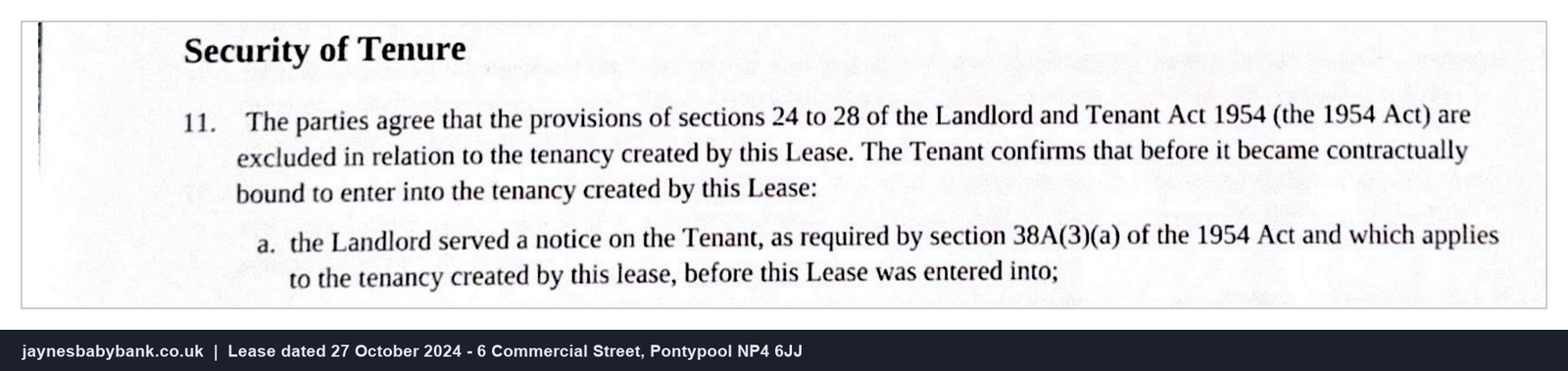
Sections 24 to 28 of the 1954 Act are what normally give a business tenant security of tenure: the right to stay on after the term ends and to demand a new lease.
They were excluded from this tenancy. The clause records that the statutory warning notice was served before she became contractually bound, and that a declaration was made in response, exactly as section 38A(3) requires — a formal two-step process that cannot happen by accident, or without the tenant taking part in it.
So at one minute past midnight on 27 October 2025, she had no contractual right to the building and no statutory right to the building. Clause 8 told her what to do about it:
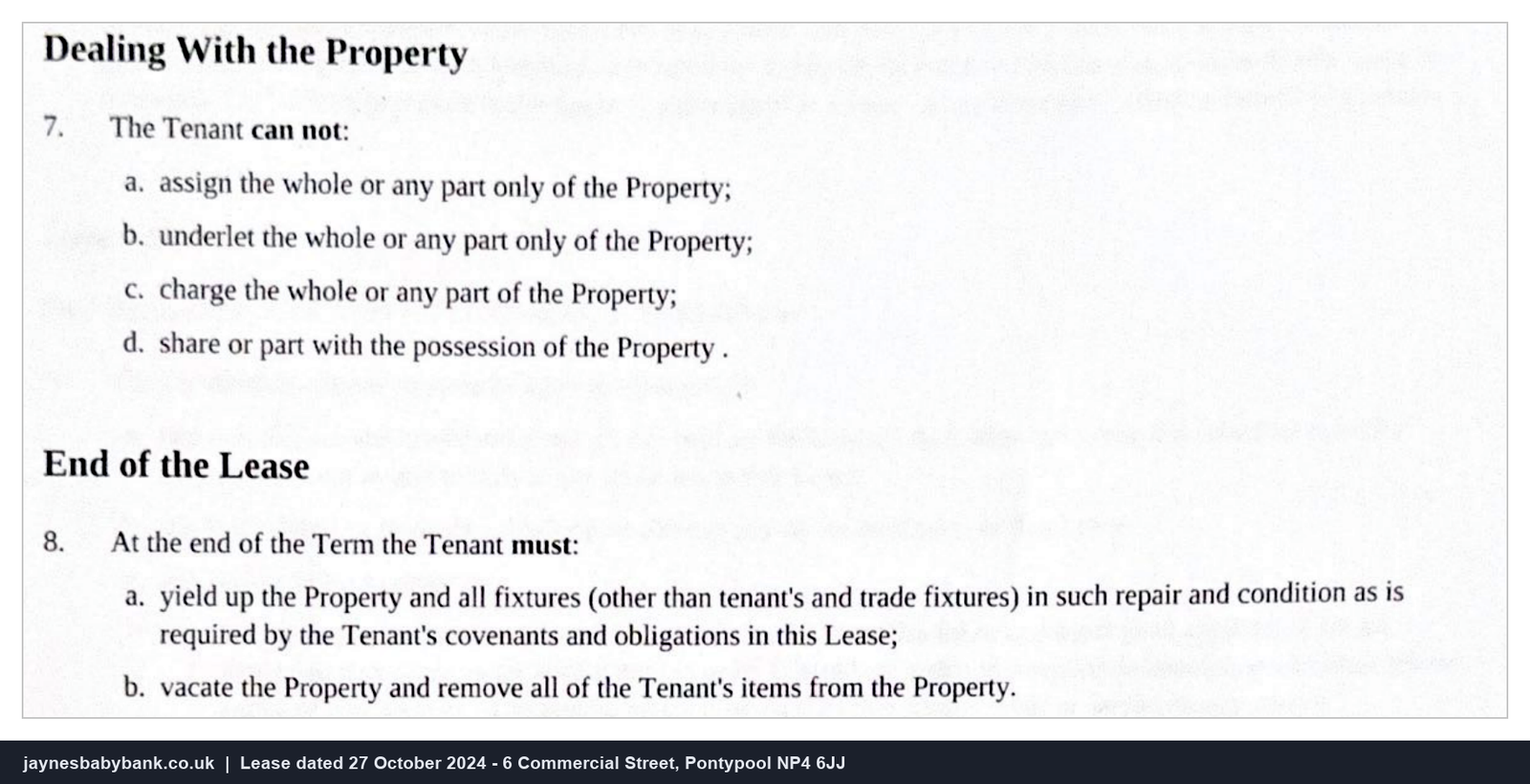
8. At the end of the Term the Tenant must:
a. yield up the Property and all fixtures… in such repair and condition as is required by the Tenant’s covenants and obligations in this Lease;
b. vacate the Property and remove all of the Tenant’s items from the Property.
She had one job on 26 October 2025: leave, and take the stock with her. Instead the premises were still full nearly eleven months later — “filled to capacity”, in the landlord’s words, “and there was very little usable space remaining”.
“Option 1”
Further down the same 17 September post, under the heading “Options we have”, is the line that ought to concern anybody who ever handed a bag of baby clothes over a counter in Pontypool:
“Options we have :-
1. Leave everything in Pontypool for the landlords to dispose of.
Jaynesbabybank Registered – cic, 17 September 2026
2. Move everrything to new premises.”
Option one is abandonment. Not storage, not redistribution to the families it was collected for, not handing it to another baby bank — disposal, by a landlord, at his expense, of goods donated by the public.
It is presented as a neutral choice between two equal options, posted between a line about being “footloose and fancy free” and a request for twenty cardboard boxes.
Under clause 8(b) it is not an option at all. The duty to “vacate the Property and remove all of the Tenant’s items” is not discharged by leaving them there for somebody else to pay to take to the tip. It would be the fourth time in five months: Caerphilly, Risca, Crane Street, and now Commercial Street. In Risca a clearance crew emptied the building on 2 July after the Torts notice expired with nothing collected.
“A landlord can write any thing and place it in the window”
From the same 16 September post:
“A landlord can write any thing and place it in the window they have typed up on a word document.”
The notice in that window cited Clause 1, Clause 8, Clause 14 and Clause 15 of a specific document. Not a Word document. This document — the one she signed as a deed in front of a witness. Here is clause 14:

14. The Landlord is entitled to re-enter upon the Property if:
a. any part of the rents hereby reserved are not paid within fourteen days after becoming due, whether formally demanded or not or any breach of any covenant in this Lease;
Fourteen days. On at least four months of arrears, the right to re-enter arose and re-arose repeatedly, long before the term even expired — and separately for “any breach of any covenant in this Lease”, of which there are a number below.
And clause 15 answers the newest theory — that possession having been resumed, the whole thing is now somebody else’s problem:
15. Upon re-entry by the Landlord this Lease shall determine absolutely but without prejudice any right of action or remedy of the Landlord in respect of any breach of the Tenant’s covenants existing at the date of re-entry.
Losing the building does not discharge the arrears. It preserves them.
The man in the building
Clause 6 is a list of things the Tenant covenanted not to do. Several of them describe what was happening inside 6 Commercial Street.
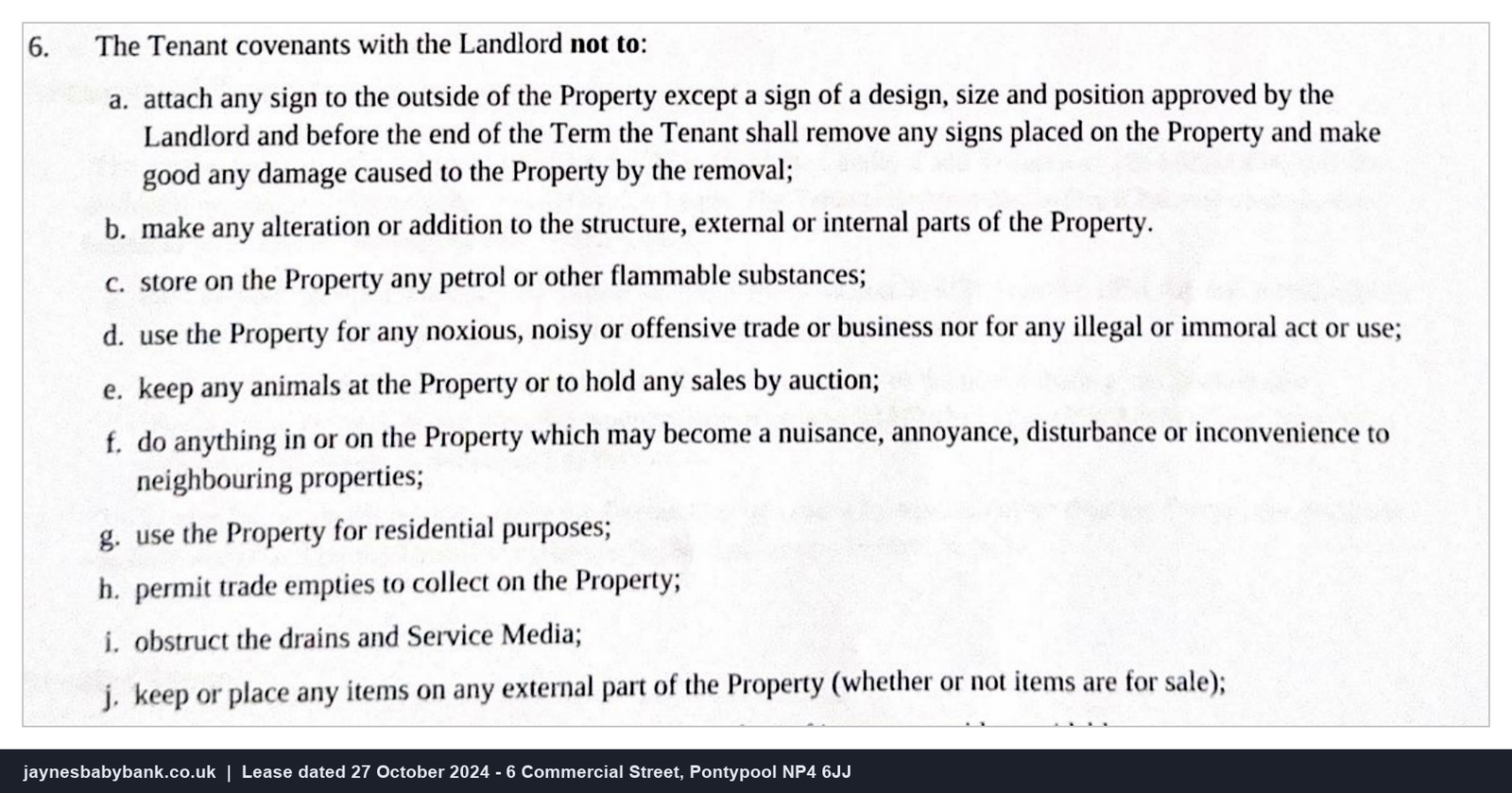
- 6(b) — not to “make any alteration or addition to the structure, external or internal parts of the Property”. 6 Commercial Street and 5 Crane Street, two units of a Grade II listed building, were knocked through. On camera, in October 2025: “Oh yeah, we’ve knocked through. I don’t mess around.”
- 6(g) — not to “use the Property for residential purposes”. On 15 September a man was living in it.
- 6(j) — not to “keep or place any items on any external part of the Property (whether or not items are for sale)”.
- 7(d) — the Tenant cannot “share or part with the possession of the Property”.
The man found in the premises in the early hours of 15 September was Raymond Derek Watkins, sentenced at Cardiff Crown Court in March 2013 for accessing, making and possessing indecent images of children and for sexually assaulting a 15-year-old girl. We reported that on 13 September. Clause 6(g) of the lease had prohibited anybody living in that building since the day it was signed.
P3: the floors she never rented
Jayne’s Baby Bank calls its Pontypool premises P1, P2 and P3. P1 is 5 Crane Street. P2 is the shop at 6 Commercial Street — the ground floor this lease covers. P3 is the upper floors of that same building, and it was a separate letting: both she and the landlord say the upstairs was not included in what she held.
What it would have cost is less clear, because she has given two figures. In one video it was “another £400 a month”. In her post of 16 September it was “£900 upstairs”. We have seen no document for either, and neither figure is in the lease.
There is a wrinkle worth putting on the table before going further, because a careful reader will spot it. The lease defines the Property broadly — “the land and buildings known as 6 commercial street” — and on those words alone you might expect the upper floors to be inside the letting. Both parties nonetheless treated them as outside it. She said repeatedly that taking them on would require a lease she had not signed; the landlord’s account is that she was using them in breach.
It does not matter which reading prevails, because neither helps her. If the upper floors were inside the demise, her repairing covenant under clause 5(g) covered the entire building including its roof, and the argument about whose job the roof was collapses on the spot. If they were outside it, she occupied them — on the landlord’s account, for seventeen months — with no tenancy of any kind.
And across sixteen months of talking about P3, there is one thing she never once claimed.
She has never claimed she signed a lease for it.
She has said the opposite, repeatedly, in her own broadcasts.
| Date | In her own words |
|---|---|
| 14 May 2025 | “PONTYPOOL PHASE 3…. SHALL WE SIGN A LEASE ?!“ |
| 13 Jun 2025 | “I’m supposed to be signing a lease with somebody else for Phase 3 Pontypool.” |
| 25 Jun 2025 | “we’ve already discussed it and agreed on a price with one of my current landlords for phase three of Pontypool.” |
| 28 Jul 2025 | “I know we got 50 in P3 that we haven’t even signed the lease for yet.” |
| 15 Feb 2026 | “we’ve spoke to landlords, P2 landlords this week about P3, because P2 landlords own P3… we might expand to P3.” |
| 7 Apr 2026 | “we’re looking to sign for P3. Knock through to P3.“ |
| 8 Jun 2026 | “We have permission to use all areas of p1, p2 and p3.“ |
| 19 Jul 2026 | “Brought down some more books… ready to start a new poundshop room in P3. Be nice to have 1 big Christmas room too in p3.” |
| 25 Jul 2026 | “Guys we are in p2/p3 most of the day.” |
| 26 Jul 2026 | “maybe 5 or 6 painted in p3 ready for when we open that to the public as additional shop floors.” |
| 30 Jul 2026 | “P1, P2, P3 are all separate landlords, separate buildings, but they’re willing to connect.” |
| 24 Aug 2026 | “before we decide to renovate p3 for shoppers… p3 no good without p2 really.” |
| 15 Sep 2026 | “We are all packed up on p1 and mostly in p3.” |
| 16 Sep 2026 | “we do not have to pay any rent for p1/p2/p3 or any shop/space once a Health and Safety Prohibition is in place.” |
Read the first and last rows together.
In May 2025 she asked her followers whether she should sign a lease for P3. In September 2026 she announced she did not have to pay the rent on it. In between, she never signed anything.
You cannot withhold rent on a lease you never signed
The 16 September post is built on a single idea: that a Health and Safety prohibition released her from paying rent. Whatever its merits for P1 and P2 — and clause by clause, it has none — it collapses entirely at P3, because there was never a tenancy there to suspend.
In an undated video she set out her own reason for not signing, and it had nothing to do with damp, mould or roofs:
“We’ve got P3. If we want it, we’ve only got to sign the lease for it. I just haven’t signed it because I don’t want to commit to another £400 a month without having some sort of funding behind us in the current climate.”
Jaynesbabybank Registered – cic, undated video
Not “the building is unfit”. Not “the landlord is in breach”. She did not want to commit to the monthly cost. That is a straightforward commercial decision, and there would be nothing wrong with it — if the space had then been left alone.
It was not. On her own account, across sixteen months, P3 held stock, was being cleared and packed, was to have a poundshop room, a Christmas room and a games room, was to be painted and “renovated for shoppers”, and was to be opened “to the public as additional shop floors”. In July 2026 she told followers “we are in p2/p3 most of the day”.
“Permission to use all areas”
On 8 June 2026, answering critics point by point, she wrote:
“3. We have permission to use all areas of p1, p2 and p3. 4. We have not received any legal eviction notices from anywhere.”
Jaynesbabybank Registered – cic, 8 June 2026
Two months earlier she had told viewers she was still “looking to sign for P3”. Ten months earlier she had said the stock was already in there and the lease was unsigned. “Permission” is doing a great deal of work in that sentence, and no document has ever been produced to support it.
There is also the question of who she would have obtained it from. On that, she has said one thing twice and the opposite once — and the odd one out arrived at a convenient moment.
In February 2026 the units shared a landlord:
“we’ve spoke to landlords, P2 landlords this week about P3, because P2 landlords own P3. A lot of our landlords own different, own other buildings, you see.”
Jaynesbabybank Registered – cic, 15 February 2026
In September 2026 they still did. Her rent post refers throughout to a single “P2/3 landlord” quoting “£550 for down stairs and £900 upstairs”. One landlord. One building. Two floors. And whatever the upstairs figure really was, the downstairs one is not a proposal: £550 is the rent on the lease at the top of this report, £6,600 a year to the penny.
Of course one landlord held both. P3 is the floors above P2. And the wider terrace is interconnected too — nobody has described that more vividly than she has, in the very same February broadcast:
“The shop was built in 1828… They’ve got tunnels under the ground blooming, stuff going on everywhere, joining attics and all the rest of it… it’s grade two listed now.”
“I can’t just knock through to another shop. We didn’t knock through to another shop. If you look at the menu, it’s a door. And doors are interconnecting all the way through Pontypool. So all we did was unlock the door.”
Jaynesbabybank Registered – cic, 15 February 2026
Then, on 30 July 2026, with enforcement closing in on the whole structure and the question of how far any notice reached becoming a live one, the buildings came apart:
“P1, P2, P3 are all separate landlords, separate buildings, but they’re willing to connect.”
Jaynesbabybank Registered – cic, 30 July 2026
Separate landlords, five months after telling viewers that one landlord held two of the three. And separate buildings — when P2 and P3 are the same building, one floor above the other, reached by her own staircase.
The February and September accounts agree with each other and with the bricks. The July one stands alone, and it arrived exactly when it became useful for the premises to be unconnected.
What the landlord says about it
The landlord’s written account addresses the same space, and dates the problem to the winter before she began publicly asking whether to sign:
Also using the Upstairs of the property as storage for 17 months. We came to know that she has broken the lease terms in relation to upstairs in January 2025.
Nasrat Shoaib, landlord, in correspondence seen by this site
What her signed lease says about the space she did not sign for
P3 was upstairs from the shop she did hold, reached through it, and that is why the lease at the top of this page still bites.
- Clause 6(b) — not to “make any alteration or addition to the structure, external or internal parts of the Property”. In April 2026 the stated plan was to “knock through to P3” — that is, through her own demised shop into the floors above it.
- Clause 7(d) — the Tenant cannot “share or part with the possession of the Property”. Not vary. Not qualify. Cannot.
And the arithmetic is worth sitting with. At least four months’ rent outstanding on the unit she did sign for — and, on the landlord’s written account, seventeen months of storage in the one she did not.
Donated goods, given by the public in Pontypool for families in Pontypool, were moved into a building that Jayne’s Baby Bank had no lease on, no written permission for, and by her own account had declined to take on because £400 a month was too much of a commitment. They were still in there on 15 September, when the locks changed.
“We have had the go ahead to remove our stock”
On 17 September, alongside a screenshot of an environmental health email:
“We have had the go ahead to remove our stock which has not been condemned by the council. And there is the email to state both premises are unfit for purpose in current state.”
Jaynesbabybank Registered – cic, 17 September 2026
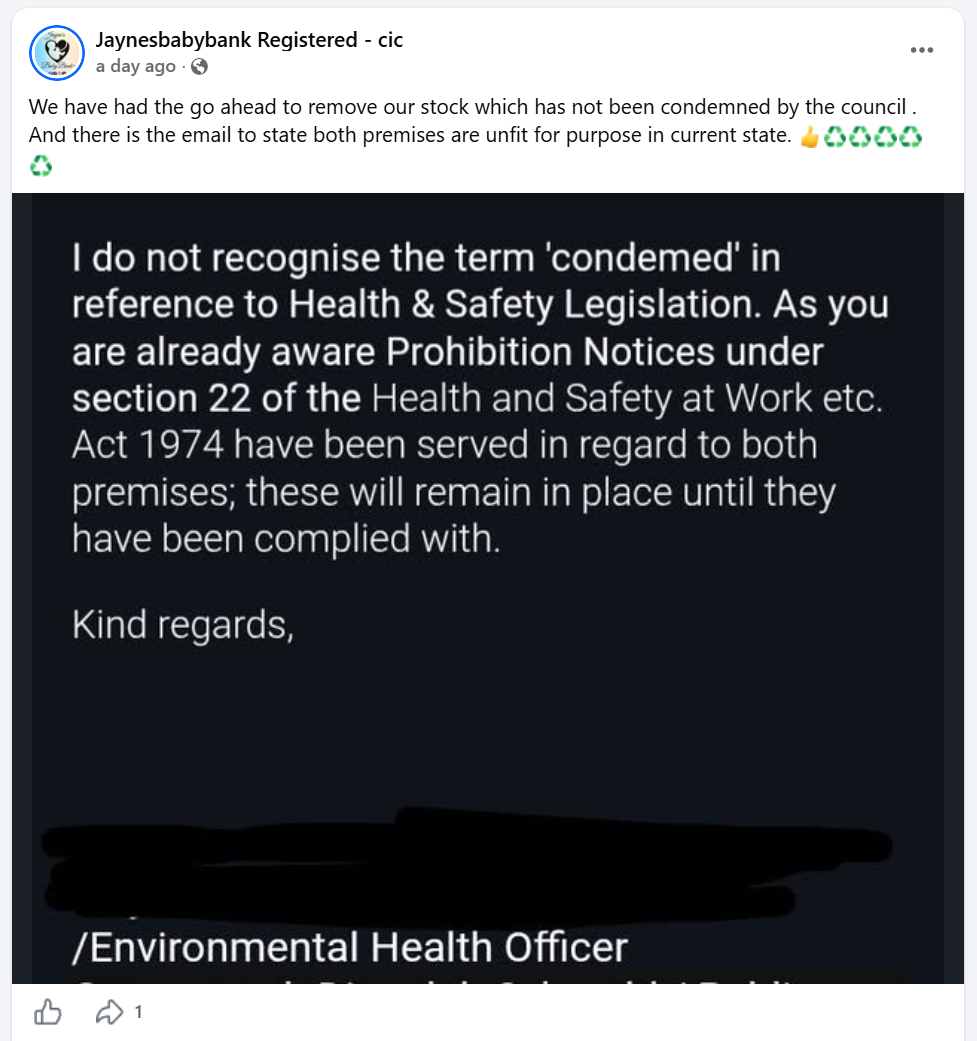
Two claims, and the evidence attached to them refutes both.
On the “go ahead”. The email in the screenshot is from an Environmental Health Officer. It says nothing about permission to enter the building or remove anything. The only person who can grant that is the man who now holds the keys, and his position is on the record:
Since retaking possession, no person has permission to enter the premises without our express authorisation. This includes the former tenant, Jayne’s Baby Bank and anybody acting on their behalf. Anyone wishing to access the property must contact us directly and obtain permission beforehand. Specially if it’s in regards to removing goods.
Nasrat Shoaib, landlord, in correspondence seen by this site
On “unfit for purpose”. The email does not say that either. It is a correction. What the officer actually wrote was:
“I do not recognise the term ‘condemned’ in reference to Health & Safety Legislation. As you are already aware Prohibition Notices under section 22 of the Health and Safety at Work etc. Act 1974 have been served in regard to both premises; these will remain in place until they have been complied with.”
Environmental Health Officer, quoted in the post itself
An officer declining to use the word “condemned”, and confirming that prohibition notices remain in force until complied with, has been reposted as proof of a council green light. It is the opposite. And the landlord will not confirm the “unfit” characterisation either:
At present, I am not aware of any formal determination that 6 Commercial Street is legally designated as “unfit for purpose”. The works identified during the Health and Safety visit, including cleaning and dealing with mould, are matters that we will address as part of putting the property into an appropriate condition.
Nasrat Shoaib, landlord, in correspondence seen by this site
It is worth noting what he does not claim. On the Prohibition Notices themselves he stops dead:
I am not currently aware of the precise details of any Prohibition Notice that may have been served, including its exact scope or whether any particular notice remains in force. I therefore do not want to misrepresent the position by confirming something that I have not personally seen or verified.
Nasrat Shoaib, landlord, in correspondence seen by this site
He is not withholding anything there. He does not know, and says so rather than guessing. It is a small thing, and it is the whole difference between the two accounts in this story: one party will not state a fact he has not personally verified, and the other has spent the week announcing what the council has decided, what the law requires and who is now responsible for the buildings — without producing a document for any of it.
“Prohibitions in our name are now void to us”
The most recent post, 18 September:
“Can we remind everyone that all our premises have cctv inside and out still including Pontypool Shops as p2 has had damage to the front of the shop. Can I remind everyone any fire prohibition on Pontypool shop or Health and safety prohibitions in our name are now void to us and as the landlords have resumed possession of Pontypool Shops so they are now responsible for the shops as a whole. We will keep you updated what happens to to the stock and equipment.”
Jaynesbabybank Registered – cic, 18 September 2026
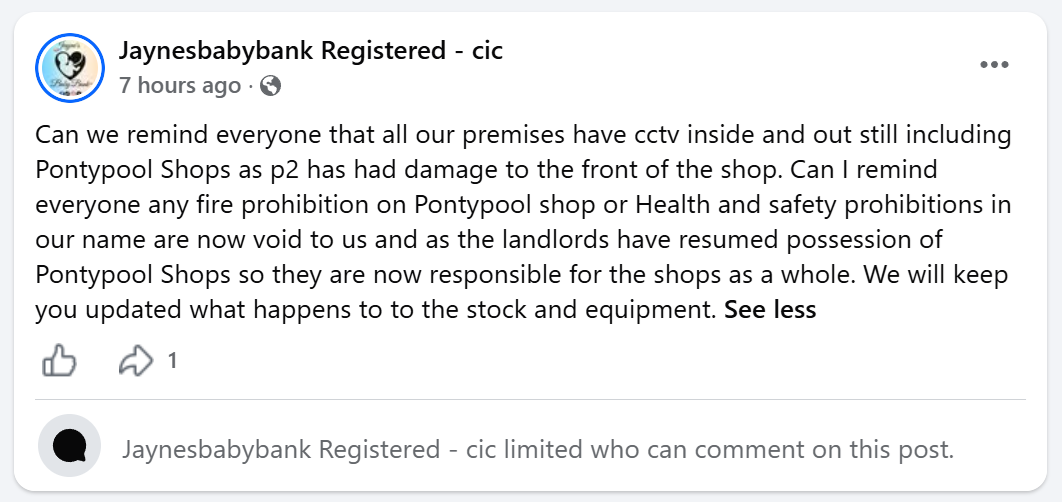
A statutory notice is not a lease, and it does not transfer with the keys. A Prohibition Notice under section 22 is served on a named person in respect of a named activity. It does not become “void” because that person has stopped having a building — and a notice served on her cannot be complied with, appealed or discharged by somebody else.
But read the two halves of that post together, because they cannot both stand.
The second half hands the building over entirely: the landlords have resumed possession, so they are “responsible for the shops as a whole”. The first half keeps it. All our premises have CCTV inside and out, still, including Pontypool — and she knows there has been damage to the front of P2.
You cannot be leaseless, footloose and no longer responsible for a building on Wednesday, and still be running cameras inside it and reporting on its shopfront on Friday. One of those is a disclaimer and the other is a claim of continuing control, and they were posted forty-eight hours apart by the same page.
Whatever equipment is or is not in that building, the position on access is not in doubt, because the man holding the keys put it in writing three days earlier: no person may enter without his express authorisation — the former tenant, Jayne’s Baby Bank, or anybody acting on their behalf. And clause 7(d) of the lease never permitted her to “share or part with the possession of the Property” in the first place.
What is genuinely true is that the landlord now has the building back and intends to clean it. He has said so, and has described the protective equipment he was advised to wear while doing it. That is not the same as the debts, the breaches, the notices or the stock becoming his.
Claim vs. contract
| The claim, 16–18 September | The deed she signed on 27 October 2024 |
|---|---|
| “Haters keep saying we don’t pay rent” (12 Jun 2026) | Not a denial. From the same 16 September post: “we would state why we stopped paying“. The reason given has changed at least six times, from the price being too high, to the roof, to a rent increase, to the landlord’s membership of a Facebook group, to prohibition notices. |
| “we do not have to pay any rent… once a Health and Safety Prohibition is in place” | Clause 5(a): rent payable monthly in advance on the 27th, by standing order. No suspension provision exists anywhere in the lease. The prohibitions post-date the end of the term by months. |
| “it is a criminal offence for them to charge any tenant rent once the prohibition is in place” | No such offence exists under the Health and Safety at Work etc. Act 1974, and none has ever been cited. Section 22 notices prohibit an activity; the offence under the Act is contravening the notice. |
| “the shops have been deemed unfit for rent/use” | Clause 10: if the Property is “unfit for occupation and use”, the Lease terminates immediately. The argument does not produce a free shop — it produces no tenancy at all. |
| “It’s not my job or the baby banks responsibility to fix a roof” | Clause 5(g): the Tenant must “keep the Property and all Landlord’s fixtures and fittings at all times in good repair and condition”. “Property” is defined as the land and buildings. Clause 9 imposes no repairing obligation on the landlord at all. Damage caused by an insured risk is excepted and is his to reinstate — but that is a narrow exception, not the general rule she stated. |
| “P2/3 landlord wanted £550 for down stairs” | Rent: “£6,600.00 per annum” — exactly £550 a month. Not an ask. A contractual term she signed. |
| “I’m now leaseless and footloose and fancy free” | Term: one year from 27 October 2024, expiring 26 October 2025. She had been leaseless for 324 days before the landlord took the building back. |
| Implication that she was entitled to remain | Clause 11: sections 24–28 of the Landlord and Tenant Act 1954 excluded. No security of tenure. No right to renew. The statutory notice was served and a declaration made before she signed. |
| “A landlord can write any thing and place it in the window” | The window notice cited Clauses 1, 8, 14 and 15 of this deed. Clause 14(a) permits re-entry where rent is unpaid for fourteen days, “whether formally demanded or not”. |
| “the landlords have resumed possession… so they are now responsible for the shops as a whole” | Clause 15: re-entry is “without prejudice any right of action or remedy of the Landlord in respect of any breach of the Tenant’s covenants existing at the date of re-entry”. The arrears survive the eviction. |
| “We have had the go ahead to remove our stock” | The landlord, in writing, 18 September: “no person has permission to enter the premises without our express authorisation… Specially if it’s in regards to removing goods.” |
| “there is the email to state both premises are unfit for purpose in current state” | The email says no such thing. It declines the word “condemned” and confirms section 22 notices “will remain in place until they have been complied with”. The landlord is “not aware of any formal determination”. |
| “prohibitions in our name are now void to us” | “In our name” is the admission. A notice served on the duty holder does not transfer with possession of a building. |
| “PONTYPOOL SUPERSTORE CAFE AND PET CAFE PENDING” (16 Feb 2025); “phase two which is the pet cafe” (17 Jun 2025) | Permitted Use is “use as a shop for the sale of Charity shop”, and clause 5(i) permits no other use. Clause 6(e) bars the Tenant from keeping “any animals at the Property”. Announced under four months after she signed. |
| “I want to get P2 open next week… we need an actual warehouse” (2 Aug 2025) | Clause 5(i) restricts use to a shop; clause 5(s) required her to keep it “open for trading” during hours usual for the area. The landlord found it “filled to capacity” with “very little usable space remaining”. |
| Trading as a “charity shop” — the Permitted Use on her own lease reads “use as a shop for the sale of Charity shop“ | Not a registered charity, and not one when the lease was signed. An application to the Charity Commission was refused in August 2023. The CIC (16838920) was not incorporated until 7 November 2025 — after the term had expired. |
| “we do not have to pay any rent for p1/p2/p3“ | There was never a tenancy at P3 to suspend. On 28 July 2025: “we got 50 in P3 that we haven’t even signed the lease for yet.” On 7 April 2026, still “looking to sign for P3”. Her stated reason for not signing was cost, not condition. |
| “We have permission to use all areas of p1, p2 and p3” (8 Jun 2026) | No document has ever been produced. Two months later she was still “looking to sign for P3”, and clause 7(d) barred her from sharing or parting with possession of the unit she had. |
| “P1, P2, P3 are all separate landlords, separate buildings” (30 Jul 2026) | She had said the opposite in February — “P2 landlords own P3” — and said it again in September, referring to a single “P2/3 landlord” quoting two floor prices. In the same February broadcast she described the units as joined by interconnecting doors and shared attics in one Grade II listed structure. |
| “We didn’t rent these buildings in these conditions to start with” | Clause 20: both parties acknowledge the lease “does not rely on any representation or warranty given by the other”. No schedule of condition is attached. On a full repairing lease the condition of the building was her risk by agreement. |
| “We have been in contact with our landlords” | The landlord, same week: the breach was known in January 2025, “since then it became chasing game to get hold of her”, she “was never available”, and “we served her notice of eviction multiple times”. |
| Sympathy for the “financial pressure for two landlords” | One of those two landlords had not been paid for at least four months — £2,200 or more. On 11 July she gave the reason: “I’m not paying any rent to a landlord who’s part of that group sorry on principle.” |
| “all our premises have cctv inside and out still including Pontypool Shops” | Posted in the same breath as “the landlords… are now responsible for the shops as a whole”, and two days after “I’m now leaseless”. The landlord’s written position is that no person may enter without his authorisation; clause 7(d) barred sharing or parting with possession throughout. |
| “Option 1. Leave everything in Pontypool for the landlords to dispose of.” | Clause 8(b): the Tenant must “vacate the Property and remove all of the Tenant’s items“. Abandoning publicly donated stock for the landlord to dispose of is a breach, not an option. |
Nine pages
For three years the answer to every document has been that it belongs to somebody else. The CCJ was not her name. The credit file was an error. The enforcement notices were the landlords’ fault. The notice in the window was something typed on a Word document.
This one is nine pages long, it is written in plain English, and it was signed by hand in front of a witness who wrote down his own address and his own job. It sets the rent at £550 a month. It puts the repairs on the tenant. It gives the landlord the building back after twelve months with no right of renewal. It says that if the place became unfit, the tenancy ended there and then. And it was signed, in October 2024, above a printed name.
Everything posted this week — the rent theory, the criminal offence that does not exist, the roof, the prohibitions, the footloose and fancy free — was an argument with a piece of paper that had already answered it.
The paperwork was always going to win, because the paperwork was always true.
What these words mean
This report quotes a legal document, so some of the words are unusual. Here is what they mean in plain English.
- Lease — the written contract that let her use the shop. Both sides signed it.
- Deed — the most formal kind of contract there is. It must be signed in front of a witness, who signs it too and writes down their own name, address and job.
- Term — how long the lease lasts. Hers was one year.
- Clause — a numbered rule inside the contract. “Clause 10” just means rule number 10.
- Covenant — a promise made in the contract. Breaking one is called a breach.
- Full repairing lease — a lease where the tenant, not the landlord, has to keep the building in good repair. Hers was one of these.
- Security of tenure — the right some business tenants have to stay on after their lease ends. Her lease took this right away.
- Prohibition notice — an order from a safety inspector telling someone to stop doing something unsafe until it is put right.
- Possession — control of the building. The landlord “took possession” when he changed the locks on 15 September 2026.
- Arrears — rent that is owed and has not been paid.
Sources and related reporting
- Four Shutters in Four Months: 6 Commercial Street Closes — 15 September 2026
- Convicted Child Sex Offender Working and Living at Jayne’s Baby Bank — 13 September 2026
- 5 Crane Street: The End of the Road for Jayne’s Baby Bank — 16 August 2026
- Torts Notice? We Took Notice — 2 July 2026
- Lights Out on Commercial Street: The JBB Warrant Explained — 19 June 2026
- Repossession Notice Appears at Former Jayne’s Baby Bank Risca Premises — 8 June 2026
- New CCJ Reveals Carrie-Anne Ridsdale Identity Previously Denied — 15 May 2026
- “Hoorah”: Public Reacts After JBB Caerphilly Unit Allegedly Reclaimed by Landlord — 7 May 2026
- The Sherlock Dossier — #EXPOSED
Note on this report
The lease reproduced above is the tenancy agreement for 6 Commercial Street, Pontypool, dated 27 October 2024. It runs to nine pages and has been seen by this site in full, including the schedules and the execution page. The images published here are cropped extracts from that document; clause references and quotations are transcribed directly from it. We do not discuss how documents reach us.
We have not published the lease in full. The landlord’s home address, his signature, and the names, addresses, signatures and occupations of both attesting witnesses have been withheld: they are third parties and they are not the subject of this report. The tenant’s name, address and signature are reproduced because they are the evidence in issue, and because the same name and the same address already appear on a public County Court Judgment.
Statements attributed to Jayne’s Baby Bank are quoted from its own public Facebook page. Written posts are reproduced as published, including original spelling and grammar. Quotations from live and recorded video are taken from transcripts of those broadcasts; transcription of speech is not perfect, and where a word is unclear we have preferred the reading least favourable to our own argument. Dates are the dates of publication. One video quoted in the P3 section carries no recoverable publication date in our archive and is identified in the text as undated; every other quotation is dated.
That at least four months’ rent remains outstanding is reported on the basis of sources this site considers reliable. It is not the only basis for the point: that the rent stopped is not in dispute, because Jayne’s Baby Bank has said so in public — “we stopped paying” — and has given a succession of different reasons for it over eight months, each quoted above with its date. The monthly figure and the interest provision are taken from the lease itself.
Charitable and corporate status is taken from the public registers. Jayne’s Baby Bank has never been registered with the Charity Commission for England and Wales; an application to register was formally refused in August 2023. Jaynesbabybank Registered CIC, company number 16838920, a private company limited by guarantee, was incorporated at Companies House on 7 November 2025. Readers can check both registers themselves. Our fuller account of the organisation’s registration history is set out in the Sherlock Dossier.
“P1”, “P2” and “P3” are Jayne’s Baby Bank’s own labels for its Pontypool premises, used consistently across its posts and broadcasts. P1 is 5 Crane Street and P2 is 6 Commercial Street. What exactly P3 denoted shifted over time in her own descriptions — a basement in June 2025, an upstairs by September 2026 — and we make no finding about which physical space it was at any given date. Nothing in this section depends on that. It depends only on what she said about signing for it, and what she said about using it.
Statements attributed to Nasrat Shoaib are quoted verbatim from correspondence seen by this site, written by him in September 2026, and represent his account rather than a finding of ours. He is named because he is named on the public notice displayed at the premises and on the lease itself. On the Prohibition Notices his correspondence is explicit that he does not know: he has not personally seen any such notice, and will not state a scope or a status he has not verified. That is a gap in his knowledge, not a refusal, and we have left it open rather than filling it. The dates given in this report for the March 2026 fire prohibition and the July 2026 environmental health prohibition come from our own earlier reporting, not from him. The environmental health quotation is transcribed from the screenshot published by Jayne’s Baby Bank itself on 17 September 2026.
Readings of the lease set out above are our reading of its plain wording and are offered as comment, not as legal advice or a legal finding. Nothing here determines any dispute between the parties, and any question of what is owed, and by whom, is a matter for them and, if it comes to it, for a court.
… Sherlock!