
After months of disputed occupation, prohibition notices, arguments over rent, repeated claims that there was no eviction, and increasingly extensive efforts to remove stock, 5 Crane Street in Pontypool has now been returned to its property owner.
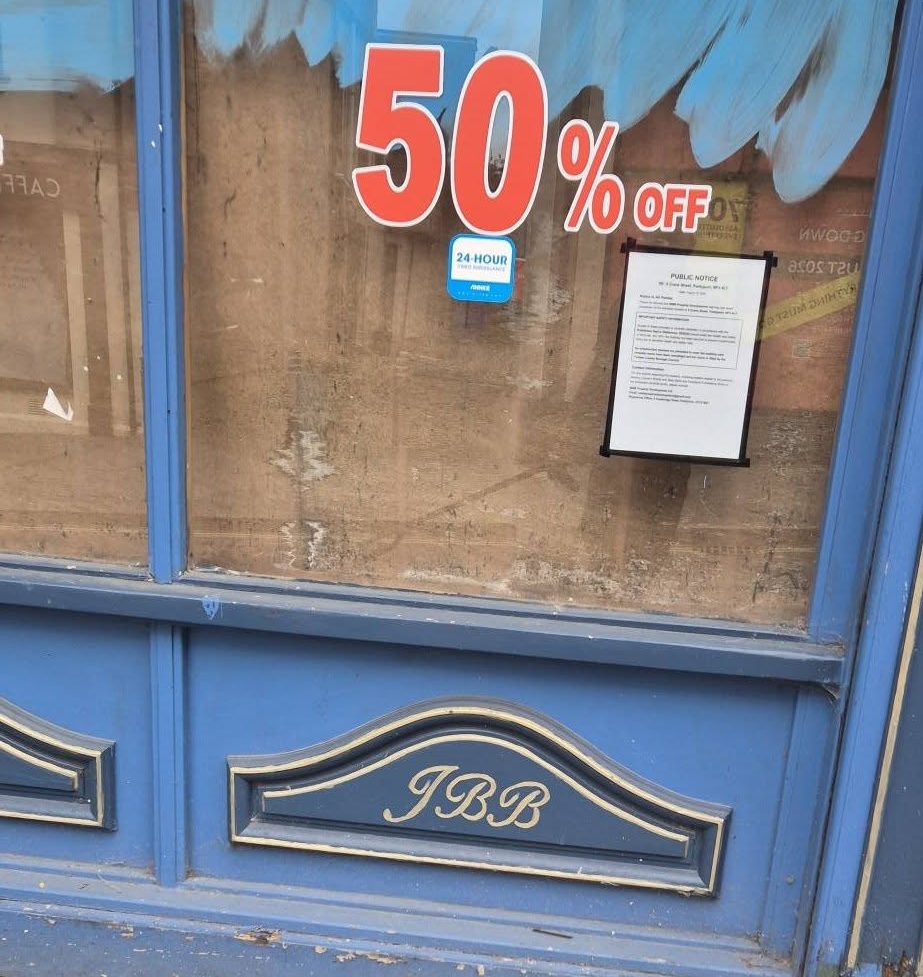
On 15 August 2026, MMB Property Development Ltd placed a public notice in the window of 5 Crane Street stating that it had taken possession of the premises. The notice states that access is restricted, that the building has been secured because of identified health and safety risks, and that unauthorised persons are not permitted to enter until remedial works have been completed and the prohibition notice lifted by Torfaen County Borough Council.
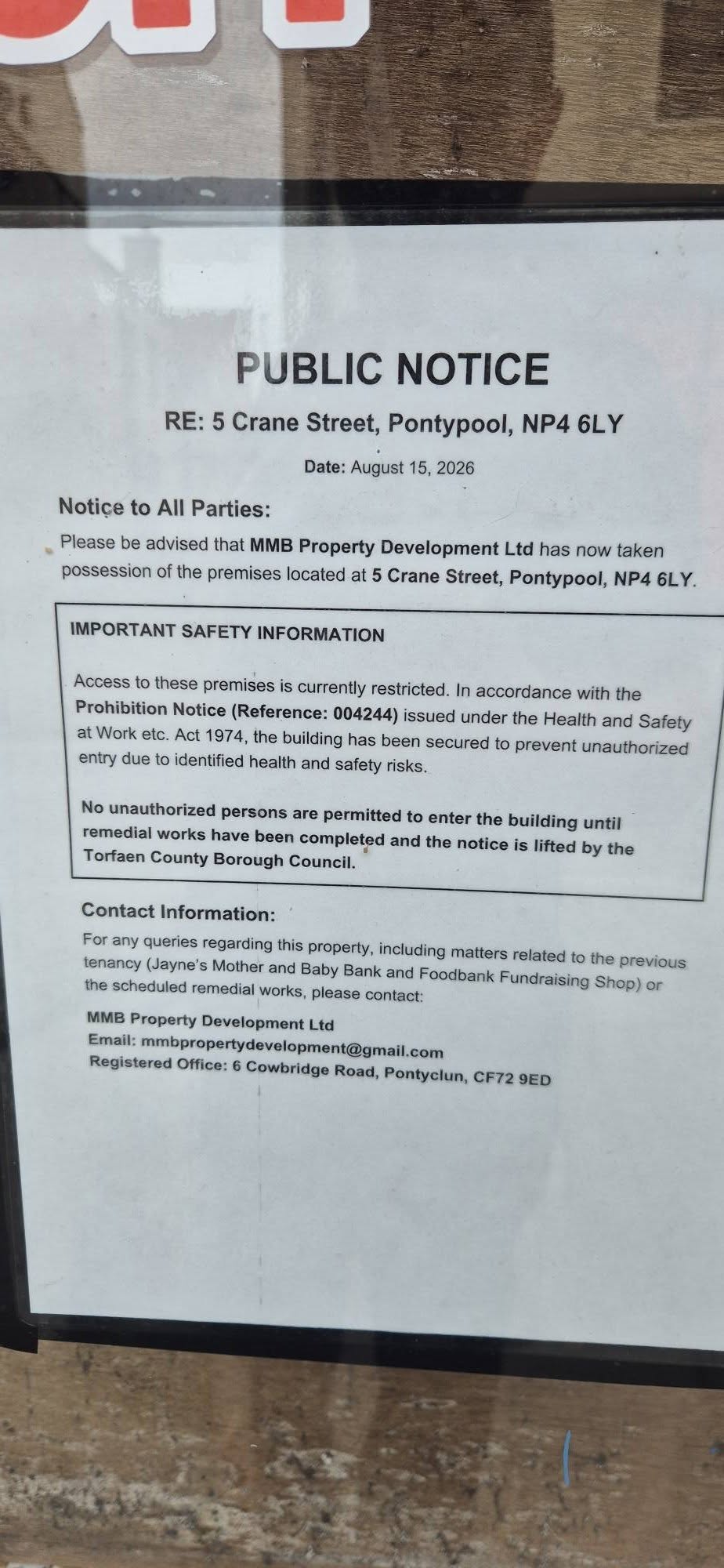
The notice identifies 5 Crane Street, Pontypool, NP4 6LY, names MMB Property Development Ltd as having taken possession, refers to Prohibition Notice 004244 and states that the premises have been secured to prevent unauthorised entry because of identified health and safety risks.
It also refers to the previous tenancy involving Jayne’s Mother and Baby Bank and Foodbank Fundraising Shop.
The notice does not, by itself, establish the precise legal mechanism by which possession was obtained. This article therefore does not describe the event as a court eviction unless the underlying possession documentation establishes that. What it does establish is that the property company publicly stated on 15 August that it had taken possession.
What Jayne’s Baby Bank was saying as possession was taken
The timing is significant because the public statements immediately surrounding the handover were not consistent with one another.
On 14 August, Carrie-Anne told customers not to leave donations at the P1 doorway and said that the landlord was carrying out a tip run. She thanked supporters for nearly four years in P1 and said they would “see you on the other side”. In the same post she said that the landlord had the keys and was storing the remaining donations and equipment.
On 15 August, Carrie-Anne again described the premises as being emptied and said that the landlord was storing equipment.
Later that evening she stated:
We gave the shop back Friday you halfwits.
On 16 August, however, Jayne’s Baby Bank rejected the description of what had happened as an eviction:
No eviction. The council closed it for the landlord to fix the problem because it breached health and saftey at work for us as tenants.
Carrie-Anne thanked the landlord for helping them move stock and for storing the remainder.
That distinction is important. The council prohibition and the landlord’s possession are not the same event. The prohibition prevented the premises from being used until the identified risk was addressed. The public notice dated 15 August records a separate fact: MMB Property Development Ltd stated that it had taken possession.
Jayne’s Baby Bank’s own posts also show that the practical process of leaving had already been underway for weeks. By early August, Carrie-Anne was publicly thanking the landlord for removing stock, reporting multiple van loads being moved to storage, and discussing the landlord taking possession of remaining equipment.
On 10 August she said that the landlord and his brother had been helping move stock and that the landlord had delivered items to storage. She also said:
You’ve actually, you know, kicked me up the bum to get in the other shop a bit quicker.
In the same material she repeatedly said:
I don’t want Crane Street.
And:
I made a massive boo-boo when I took on Crane Street.
Those statements sit alongside an earlier history in which Carrie-Anne had repeatedly presented continued occupation and renewal of the premises very differently.
From “there is no eviction” to possession being taken
The central dispute began on 24 July 2026, when environmental health prohibition documentation was served in relation to 5b Crane Street.
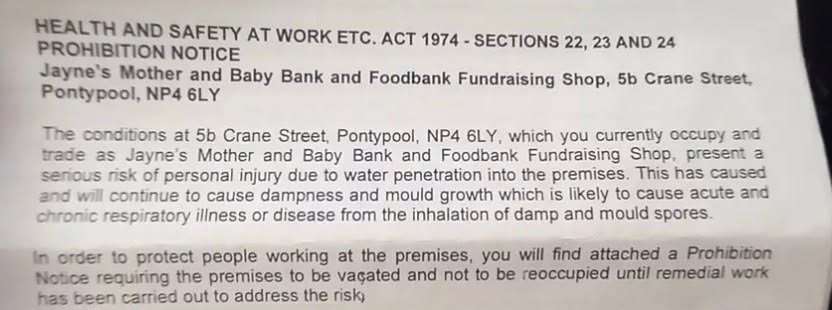
The covering letter records a serious risk of personal injury caused by water penetration, dampness and mould growth. It states that the premises were required to be vacated and not reoccupied until remedial work had addressed the risk.
A second prohibition notice was also served on MMB Property Development Ltd in relation to matters contained in the same documentation.
Within hours, however, Carrie-Anne repeatedly told the public that she had not been evicted.
There is nothing on the door at all.
She said that the council had served the landlord, that she had received no eviction documentation and that the landlord would have to carry out the work.
On 25 July she described the position again:
Why didn’t they pick me up and drag me out and say, that’s it, you’re not squatting here anymore.
She also asked why a landlord would have allowed somebody to remain in a property for so long if they were allegedly squatting.
The narrow point was correct. A prohibition notice is not itself an eviction notice. It does not terminate a tenancy or automatically transfer possession.
But that was never the whole issue.
The fixed term of the 2023 lease had already expired on 16 January 2026. The lease records an exclusion of security of tenure. Carrie-Anne had also subsequently stated that the landlord had emailed on Christmas Eve 2025 giving 17 days to vacate.
What followed was therefore not simply a question of whether the council had physically evicted Carrie-Anne on 24 July. The more important question was what happened after the prohibition, and whether Jayne’s Baby Bank ultimately left when the property owner sought possession.
By 15 August, the property company was publicly stating that possession had been taken.
The contradiction over whether she wanted Crane Street
One of the clearest changes in position concerns whether Carrie-Anne ever wanted to remain at 5 Crane Street.
On 26 July, she said:
I was happy to renew and they work around me.
Less than a day later, on 27 July, she said:
We don’t want to renew the lease and never did.
Those statements were not made months apart. They were made roughly seventeen hours apart.
But the history goes back considerably further.
| 14 October 2025 | “I have got a couple of leases to renew. One before New Year, one after New Year. We have already agreed on that.” |
| 9 November 2025 | “We’re going to be busy the next couple of months because we’ve got contracts to renew.” |
| 9 January 2026 | “We’ve got leases to sign, leases to renew going forward.” |
| 16 January 2026 | “Good news! We are about to renew all our leases at current venues 3-5 years!” |
| 27 July 2026 | “We don’t want to renew the lease and never did.” |
The final statement therefore did not merely differ from something said the previous evening. It reversed a series of statements made over the preceding months, including one published on the very day the fixed term expired.
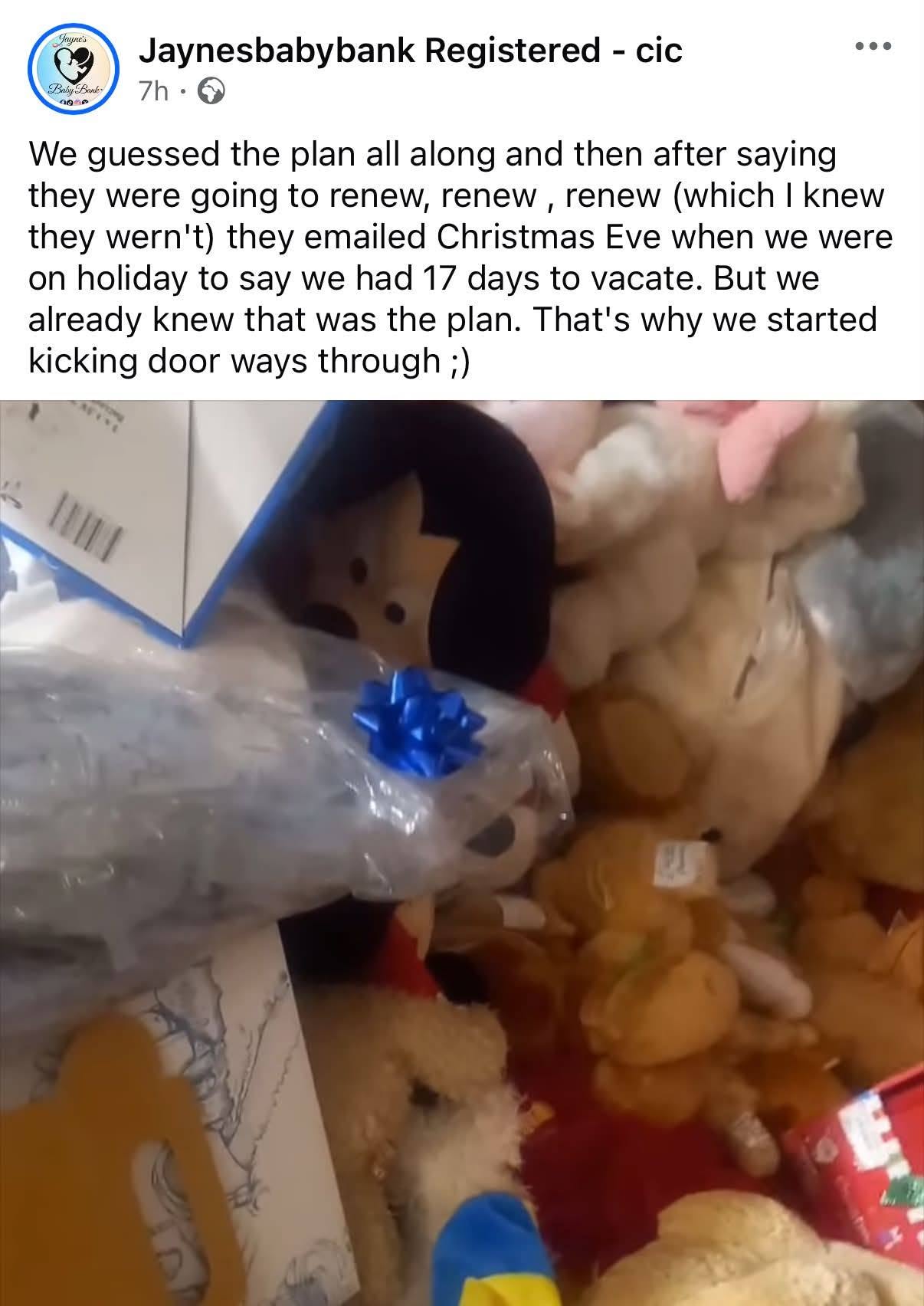
On her later account, the landlord had emailed on Christmas Eve 2025 giving 17 days to vacate. Carrie-Anne said she already knew the landlord did not intend to renew and that this was why they had begun moving operations elsewhere.
Yet three weeks after that alleged demand to leave, she publicly announced that all leases were about to be renewed for three to five years.
That creates one of the clearest chronological contradictions in the entire Crane Street story: an alleged 17-day request to vacate on Christmas Eve, followed shortly afterwards by a public announcement that all current venues were about to be renewed for three to five years.
The lease had already expired
The 2023 lease for 5 Crane Street commenced on 17 January 2023 and ran for a fixed term of three years to 16 January 2026.
The rent was £4,800 per annum, equivalent to £400 per calendar month. Clause 14 records an exclusion of security of tenure.
The lease therefore provides important context for the events of August.
By the time the environmental health prohibition was served on 24 July, the fixed term had been over for more than six months.
Carrie-Anne herself acknowledged this on 27 July:
Our lease ended 16/1/26.
On 18 July she had previously argued that the absence of a publicly available renewal document did not prove that she had no arrangement with the landlord:
You don’t know what arrangements I’ve got with landlords.
She also argued that a landlord would not leave somebody with that quantity of stock in a property without a lease.
Whatever private arrangements may or may not have existed after 16 January, no new executed lease has been produced in the material examined for this article. What can be established from the 2023 lease is that the fixed term ended on 16 January 2026.
Rent: from “we have always paid” to “I haven’t got to pay”
The rent position also changed repeatedly.
| 15 June 2026 | “We have always paid our rent and have statements to prove it.” |
| 18 June 2026 | “I pay my rent.” Shortly afterwards: “I won’t pay my rent if any of the landlords are in this group.” |
| 25 July 2026 | “I don’t have to pay rent as the council have said the building is unfit for a tenant.” |
| 26 July 2026 | “I haven’t got to pay any rent.” |
| 27 July 2026 | “we paid the 3 years, and 2 months after.” |
The earlier 2023 statement was different again:
Rent paid in full 2 months at a time.
This article does not determine whether rent was actually unpaid. That would require the relevant financial records and, if disputed, the appropriate legal process.
What the public record does establish is that the explanation changed.
The July prohibition cannot itself explain an alleged rent position beginning in March, because the prohibition was not served until 24 July. Carrie-Anne’s own later statement that the lease ended on 16 January and that two additional months had been paid takes that account only to approximately mid-March.
The August possession therefore occurred against a background in which the tenancy had already expired, rent had become disputed, and Jayne’s Baby Bank had publicly asserted both that it had always paid and that it was no longer required to pay.
The condition of the building was not a new discovery
The environmental health documentation establishes the seriousness of the condition in July. This article does not dispute that finding.
The important question is when Carrie-Anne herself knew about the problems.
Her own posts take the history much further back.
On 25 November 2023, she wrote that the roof had been leaking for 456 days. That calculation reaches back to August 2022, before the January 2023 lease commenced.
On 16 June 2026 she wrote that the landlord had allegedly had 24-hour access seven days a week and that ceilings were falling because of the leak.
On 19 June she filmed mould inside the premises and said:
look at that mould that we’re just getting worse with.
On 1 July, three weeks before the prohibition, she said:
we are available at least 12 hours a day, seven days a week, for them to do work.
She also linked the condition of the building to stock removal:
These are all free because I can’t hang them up, see guys, because of the leak.
On 23 July, the day before the environmental health documentation, she was still discussing contractors and the historic damp and leaks.
The water penetration identified in the prohibition was therefore not something that first appeared on 24 July.
Jayne’s Baby Bank’s own public record shows that leaks, damp and mould had been discussed for years.
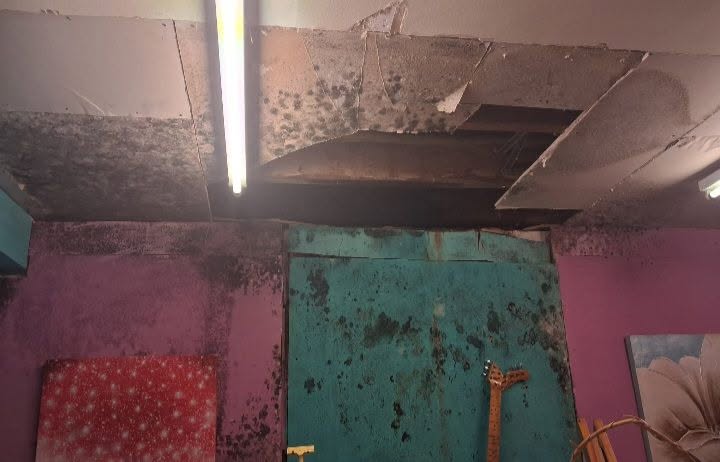
A reminder: Crane Street had already been the subject of fire safety enforcement
The events at 5 Crane Street in July and August did not occur in isolation.
In April 2026, this investigation published 72 Pages of FOI Disclosures Expose Widespread Fire Safety Failings at Jayne’s Baby Bank, based on 72 pages of Freedom of Information material from South Wales Fire and Rescue Service.
Those records documented a lengthy history of fire safety intervention at Jayne’s Baby Bank premises. At 5 Crane Street, a professional Fire Risk Assessment dated September 2025 had assessed the premises as presenting a “Substantial Risk” to life from fire. Among the issues recorded were excessive combustible stock, obstructed escape routes, a damaged and propped-open fire door, defects affecting fire compartmentation, a faulty fire alarm panel, inadequate emergency lighting and an absence of documented evacuation procedures.
The FOI material also showed that South Wales Fire and Rescue Service had been attempting to bring the premises into compliance for more than a year. Officers recorded blocked access and excessive stock in January 2025, issued a fire safety letter and Schedule of Works in April 2025, returned following further concerns in June, and recorded in September that “no actions appear to have been taken”.
A Prohibition Notice was subsequently served on the Pontypool premises in March 2026, legally preventing commercial use. The investigation’s April report also documented a further inspection after reports that the shop was continuing to trade, with officers observing members of the public entering and stock and advertising boards positioned outside in a manner giving the “clear impression that the premises was open for business”.
That history provides important context for what happened next.
First came the fire safety prohibition. Then came continued regulatory scrutiny. Then, on 24 July, the premises became subject to an environmental health prohibition concerning water penetration, dampness and mould. Finally, in August, after the stock had been progressively removed, the property owner publicly stated that it had taken possession of 5 Crane Street.
In other words, the story did not end with one prohibition notice or a dispute with one regulator. The Crane Street premises had already accumulated a documented history of fire safety intervention before the later environmental health action and the eventual loss of possession.
The significance is not that every enforcement action had the same legal basis. They did not. The fire safety proceedings and the later environmental health prohibition concerned different regulatory powers and different risks. The significance is that multiple regulatory concerns had arisen at the same premises before the property was ultimately secured and possession was taken.
By 15 August 2026, the public notice on the door no longer described a shop awaiting another argument over its future. It stated that MMB Property Development Ltd had taken possession and that access was restricted because of identified health and safety risks.
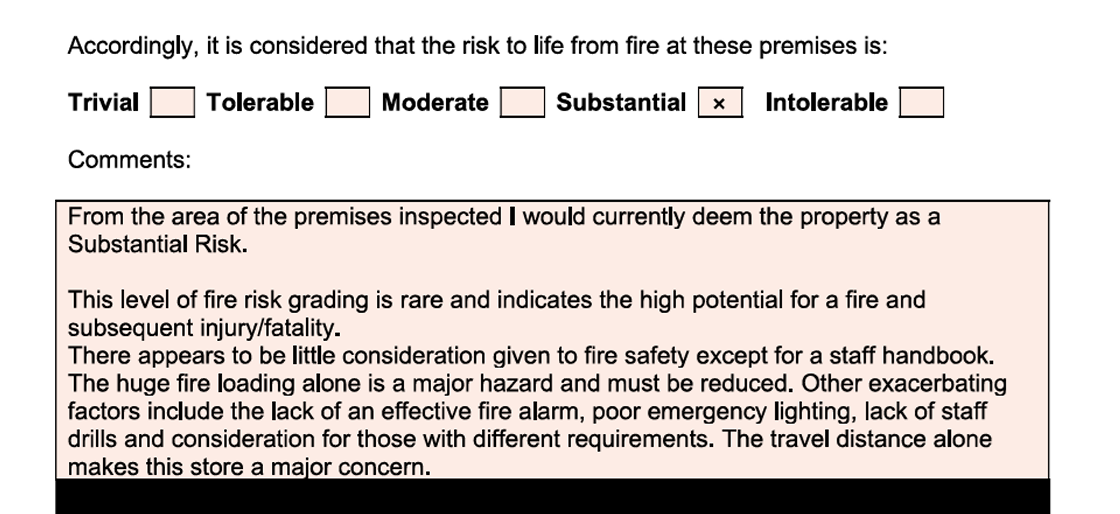
Then came the prohibition
On 24 July, environmental health served documentation concerning 5b Crane Street.
The document records a serious risk of personal injury from water penetration, dampness and mould growth and states that the premises were required to be vacated and not reoccupied until remedial work had been completed.
It also records a second prohibition notice against MMB Property Development Ltd concerning the same matters.
Following the prohibition, Carrie-Anne concentrated heavily on the fact that the landlord had also received a notice.
That fact is correct.
But it did not mean that Jayne’s Baby Bank’s own notice disappeared.
The two notices imposed different obligations on different parties. The property company was the party required to deal with matters falling within its notice. The occupier was the party required not to continue using the premises in circumstances where the prohibition applied.
That distinction became increasingly important as the dispute moved from the council’s prohibition to the question of possession.
What happened at the neighbouring 6 Commercial Street premises?
The Crane Street story should not be confused with the adjoining 6 Commercial Street premises.
6 Commercial Street is the neighbouring property connected to the wider Jayne’s Baby Bank operation. It was separately subject to a warrant concerning the disconnection of its electricity supply.
The investigation also holds first-hand material, together with unreleased imagery and footage, concerning continued occupation of the connected Commercial Street premises.
In particular, the investigation has material showing that Carrie-Anne was staying at the property during the period leading up to the final clearance of the Crane Street premises. Public material also places her at the Pontypool operation during the early hours of the morning, including livestream activity from the store.
The significance is not simply where somebody happened to sleep on a particular night. It is relevant to the chronology because the public narrative around the closure suggested that the operation was being moved elsewhere, while material held by this investigation indicates that the connected Commercial Street premises continued to be used as a base during the same period.
The distinction between 5 Crane Street and 6 Commercial Street is therefore important throughout this article.
5 Crane Street is the premises for which MMB Property Development Ltd publicly stated on 15 August that it had taken possession.
6 Commercial Street is the neighbouring premises which had separately been subject to the electricity disconnection warrant and which forms part of the wider story of where Jayne’s Baby Bank’s activities continued.
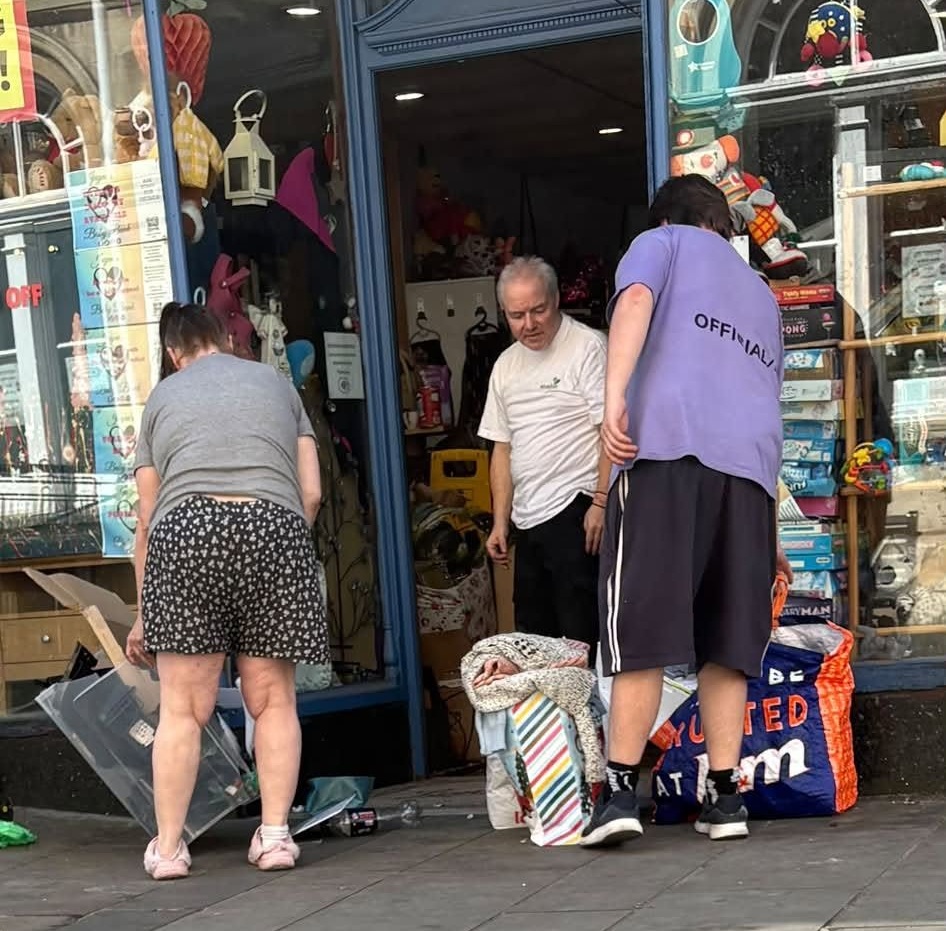
Raymond Derek Watkins at the 6 Commercial Street premises during the clearance period. The image relates to the neighbouring property and not to the 5 Crane Street possession notice.
This is also where another part of the story emerges.
Raymond Derek Watkins was associated with the premises in a security role. He was not simply introduced to this investigation as a name appearing during the final stock removal. Material held by this investigation places him at the connected Commercial Street premises during the relevant period.
His criminal history is separately documented. Watkins was convicted after admitting six offences involving access to child sexual abuse images and was sentenced to 15 months in prison at Cardiff Crown Court.
Those offences did not occur at Jayne’s Baby Bank and this article does not suggest that they did.
The relevance here is his subsequent association with the premises and the role he was understood to perform around the Jayne’s Baby Bank operation, including the reported security role.
That aspect of the story will be examined separately.
“We are working together”
One of the most striking features of the weeks following the prohibition is the change in the relationship Carrie-Anne publicly described with the landlord.
On 30 July she said the landlord was working on transportation and storage and that they were working together.
On 1 August she thanked the landlord for helping move items and said that she and the landlord were working as a team.
On 2 August:
2 vans full shifted to storage today – thank you to the landlord
On 9 August:
Thank you to the landlord and his brother and our volunteers today! 3 vans full shifted and sorted!
On 10 August she described the landlord as helping move and store the remaining goods and said he had delivered items to storage.
By 14 August she was saying that the landlord had the keys.
By 15 August she said the shop had been given back.
On 15 August the property company posted its own notice stating that it had taken possession.
On 16 August she said there had been “no eviction”, while thanking the landlord for helping them move and store stock.
The terminology remained disputed. The physical position did not.
The stock, the free items and the changing explanation
Immediately after the prohibition, Carrie-Anne repeatedly stated that the landlord was legally required to remove the stock.
On 26 July she described this as a point on what she called a schedule of work. She said that the landlord would have to pack up the contents, give them to her and move them to P2.
She also claimed that if the stock was condemned it would become toxic commercial waste and that compensation would be due.
No document examined for the original article established either proposition.
Her later conduct was more straightforward.
By early August, Carrie-Anne was working with the landlord to remove the stock. Vans were being used. Items were being stored. Equipment was being moved. The landlord was reportedly storing remaining items.
At the same time, Jayne’s Baby Bank was actively placing items outside the premises and making goods available for members of the public to take.
On 1 July she had already publicly described goods as free because she could not hang them up due to the leak:
These are all free because I can’t hang them up, see guys, because of the leak.
Following the prohibition, further items were made available to the public. Jayne’s Baby Bank also publicly discussed taking or dropping items to other locations, including local leisure centres and hospitals.
The significance is not that every item removed from the premises was necessarily contaminated. That has not been established.
The significance is the sequence: a premises subject to serious health and safety intervention, a prohibition concerning dampness and mould, public warnings concerning respiratory exposure, stock being removed, items being left outside for members of the public to take, and further items being discussed for distribution elsewhere.
On 16 August she thanked the landlord for helping them move and save as much stock as possible.
The August record therefore provides a useful contrast with the earlier July suggestion that the landlord’s obligation to remove the stock was something imposed upon him irrespective of cooperation.
Access: “24 hours a day” versus a locked door
Access was another recurring point of dispute.
On 16 June Carrie-Anne said the landlord had 24-hour access seven days a week.
On 19 June, referring to officials entering the premises, she said:
They didn’t have to break in. They didn’t need a warrant. We let them in.
On 1 July she said the premises were available at least 12 hours a day, seven days a week, for work to be carried out.
After the prohibition, however, she also said:
We have to lock the door because the fire don’t want anybody just walking in here.
A witness account recorded in the original investigation stated that environmental health officers were allowed a period to remove what was needed and that entry was subsequently refused when officers returned. That account was put to Torfaen County Borough Council.
The article does not treat the witness account as an established finding. It records it alongside Carrie-Anne’s own statements.
What is established is that access became a significant issue after the prohibition and that the premises were ultimately secured by the property company.
Officials kept returning
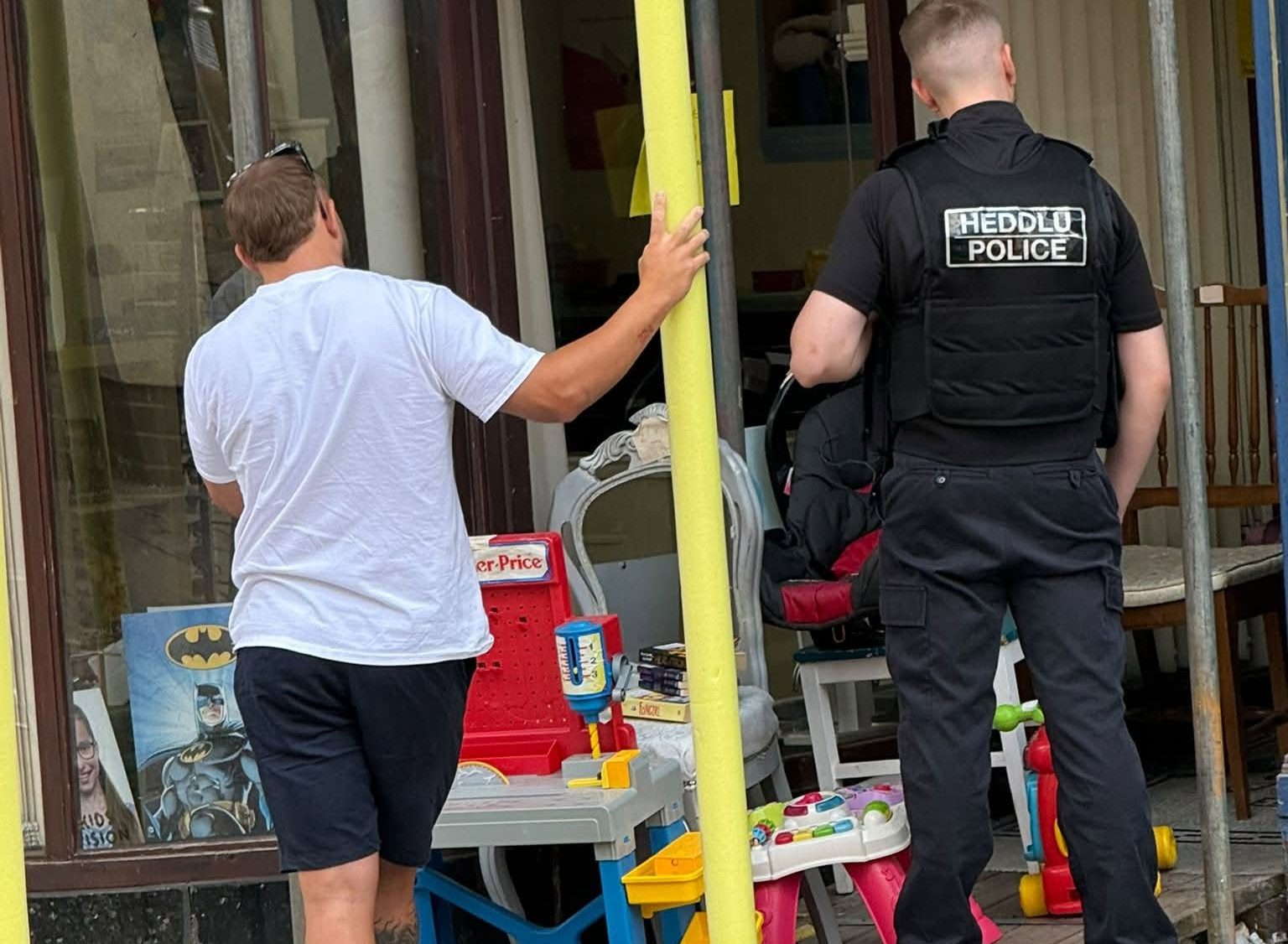
There was a recurring pattern in Carrie-Anne’s public descriptions of official attendance.
On 24 July she said the council had come for the landlord.
On 27 July she said council officers in the street were not on her side of the street.
On 29 July police attended the Crane Street frontage. A director of MMB Property Development Ltd was also present and goods were visible on the pavement.
Her public explanation was that police had attended because somebody had falsely reported children locked inside and that she was at home.
Police tuned up because one of them lied and said there were children locked inside. I have a security team and volunteers inthe correct accessible areas. I’m at home having a day off.
The nature of the report which prompted that police attendance has not been established here.
What is documented is that police attended the premises, that a director of the property company was present and that goods were outside.
South Wales Fire and Rescue Service material also records earlier restrictions around the adjoining Commercial Street premises, including locked external doors and stock restricting internal access.
These events matter because the dispute was no longer simply about a leaking roof. By late July it involved environmental health, fire safety, police attendance, the property owner, stock removal and the question of who had lawful possession of which part of the building.
The public health warning and the free stock
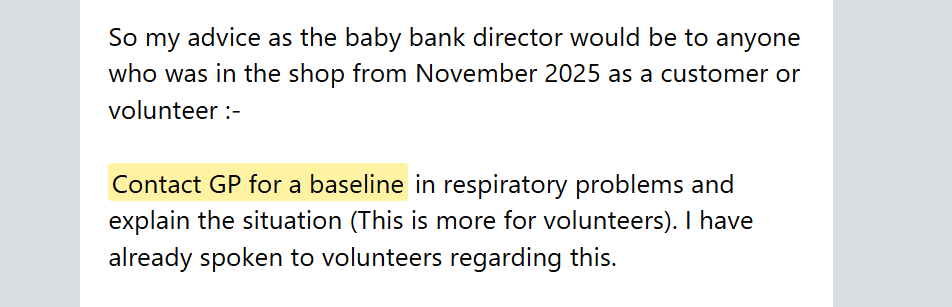
On 25 July, immediately after the prohibition, Carrie-Anne published a notice advising people who had been in the shop since November 2025 to contact their GP for a respiratory baseline.
Contact GP for a baseline in respiratory problems and explain the situation.
In the same period she was advertising goods for removal and inviting members of the public, including children, to take items from a free trolley at P2.
Free trolley at p2 door way has loads in there please take what you want. Children please only take items you want home with you do not fly tip them.
The article does not claim that the P2 stock was from the prohibited unit. The addresses are distinct and that distinction matters.
What is significant is the timing: Carrie-Anne was simultaneously telling the public that people exposed to the premises should seek medical advice while organising the removal and distribution of stock.
She was also publicly discussing leaving goods outside the premises free to take and distributing items to other public locations.
The overnight occupation
The public chronology also requires another point to be addressed.
During the weeks surrounding the closure, Carrie-Anne continued to use the Pontypool premises outside normal trading hours. The investigation holds first-hand accounts together with unreleased imagery and supporting material concerning her continued presence at the premises.
There is also a public trail of early-hours livestreams from the Pontypool operation. These broadcasts are relevant because they provide contemporaneous evidence of activity at the premises outside normal shop opening hours.
The underlying unreleased material is not being published at this stage.
The point is not to claim that every appearance at the premises constituted unlawful occupation. The point is that the public narrative of the premises simply being closed or moved away does not accurately describe the full chronology of her continued presence around the Pontypool operation.
The investigation’s material indicates that Carrie-Anne was sleeping at the premises for weeks during this period, including material concerning her presence at the connected Commercial Street property.
That material is being retained for evidential purposes rather than published in full at this time.
The “I don’t want Crane Street” claim
By August, Carrie-Anne had increasingly reframed the closure as something beneficial to Jayne’s Baby Bank.
On 30 July she said the closure had done her a favour because she could operate from another shop.
On 1 August she said she had the shop she wanted and did not need to be in Crane Street.
On 10 August she repeatedly stated:
I don’t want Crane Street.
She described taking the premises as a mistake:
I made a massive boo-boo when I took on Crane Street.
She also said that the people reporting Crane Street had effectively created problems for the landlord and had “put the nail in Crane Street”.
Yet the earlier record tells a different story.
In October 2025 she said leases were being renewed.
In January 2026 she announced three to five year renewals as “good news”.
In July she said she had been happy to renew.
Only after the prohibition and the possession dispute had developed did the public position become that she never wanted to renew and did not want Crane Street anyway.
The landlord had been trying to recover the premises
The final possession did not suddenly begin on 15 August.
The fixed-term lease had expired on 16 January 2026. Material held by this investigation indicates that the property owner had been seeking to recover the premises for months before the final possession notice appeared.
Carrie-Anne’s later account that she received an email on Christmas Eve giving 17 days to vacate is particularly significant when viewed alongside the subsequent lease-renewal claims.
The chronology is therefore not simply:
prohibition → eviction.
It is:
lease expiry → dispute over renewal → continued occupation → fire safety intervention → continued use and disputes over access → environmental health prohibition → progressive stock removal → landlord assistance with clearance → landlord obtains keys → possession notice.
By August, the landlord was no longer simply discussing repairs. The landlord was helping remove stock and store equipment.
The property’s owner had been attempting to recover the premises, while Carrie-Anne’s public explanation of whether she wanted to remain there changed repeatedly.
That context matters when assessing the final possession notice.
The sequence matters
Viewed individually, each statement can be given an explanation.
Viewed chronologically, the sequence is harder to ignore.
The roof had allegedly been leaking for years. Carrie-Anne publicly documented damp and mould. The fixed term expired in January. She nevertheless announced that leases were being renewed for three to five years. A fire prohibition followed in March. Rent was still described as paid in June and July. Environmental health then prohibited reoccupation. She said there was no eviction and nothing on her door.
She subsequently said she did not want to renew and never had.
Then the landlord began helping move the stock.
By 14 August she said the landlord had the keys.
On 15 August she said the shop had been given back.
On 15 August MMB Property Development Ltd posted a notice stating that it had taken possession.
On 16 August she said there had been “no eviction”, while thanking the landlord for helping move stock and store what remained.
The terminology remained disputed. The physical position did not.
The August timeline
- 1 August 2026. Carrie-Anne says she has the shop she wanted and that the Crane Street situation has effectively pushed her towards the alternative premises. Stock is being moved and stored with the landlord.
- 2 August 2026. “2 vans full shifted to storage today – thank you to the landlord.”
- 3 August 2026. Video material shows stock being packed and prepared for the landlord to move.
- 5 August 2026. She states that Torfaen Council closed one shop because of mould and says the landlord had to remove stock to protect her from mould caused by roof damage.
- 8 August 2026. She discusses the shop no longer being hers and refers to the landlord and the remaining stock.
- 9 August 2026. “Thank you to the landlord and his brother and our volunteers today! 3 vans full shifted and sorted!”
- 10 August 2026. Carrie-Anne repeatedly says she does not want Crane Street, describes the landlord as helping with storage and transport, and says the prohibition has effectively accelerated her move elsewhere.
- 11 August 2026. She says they are packaging and salvaging stock while waiting to find out what will happen to the remaining contents.
- 13 August 2026. She says a large amount has been emptied and asks for additional storage space.
- 14 August 2026. She tells people not to leave donations at P1 and says the landlord has the keys and is storing the remaining donations and equipment.
- 15 August 2026. She says: “We gave the shop back Friday.” The property company’s public notice, dated 15 August, states that MMB Property Development Ltd has taken possession of 5 Crane Street.
- 15 August 2026. Photographic material from the connected 6 Commercial Street premises shows Raymond Derek Watkins at the property during the clearance period. The 6 Commercial Street property is separately associated with the electricity disconnection warrant.
- 16 August 2026. Carrie-Anne says: “No eviction”, while thanking the landlord for helping move stock and store what remained.
What is established, and what remains a claim
Established by the material examined:
- The 2023 lease ran from 17 January 2023 to 16 January 2026.
- The lease records an exclusion of security of tenure.
- Environmental health prohibition documentation was served on 24 July 2026.
- The documentation identifies serious risks arising from water penetration, dampness and mould.
- The documentation required the premises to be vacated and not reoccupied until remedial work addressed the risk.
- A second prohibition notice was recorded against MMB Property Development Ltd in relation to the same matters.
- Carrie-Anne published statements acknowledging longstanding leaks, damp and mould.
- Stock was progressively removed from the premises during August.
- Carrie-Anne stated that the landlord had the keys before the possession notice was posted.
- MMB Property Development Ltd posted a public notice dated 15 August 2026 stating that it had taken possession of 5 Crane Street.
- The notice states that access is restricted and the building has been secured against unauthorised entry.
- The neighbouring 6 Commercial Street premises were separately subject to a warrant concerning electricity disconnection.
- Photographic material places Raymond Derek Watkins at the 6 Commercial Street premises during the clearance period.
Claims or matters which should remain identified as such:
- Whether all rent was paid throughout the period of occupation.
- Whether any post-expiry private agreement existed between Carrie-Anne and the property owner.
- Whether the landlord was legally responsible for every defect identified in the premises.
- Whether compensation is owed for stock or other losses.
- Whether any stock was legally required to be removed by the landlord rather than by Jayne’s Baby Bank.
- The precise legal mechanism by which possession was obtained.
- The precise circumstances of any alleged refusal of access on 24 July.
- The full extent and precise duration of Carrie-Anne’s overnight occupation, beyond the first-hand and unreleased material held by this investigation.
What happened to the “eviction” argument?
There is an important distinction in the terminology.
On 24 July, Carrie-Anne repeatedly challenged the word “eviction”. She was correct that a prohibition notice was not itself an eviction and that no eviction documentation had been identified at that stage.
That argument, however, did not establish a right to remain indefinitely.
The tenancy had a fixed end date. The property owner subsequently sought possession. The premises became subject to prohibition. Stock was progressively removed. The landlord obtained the keys. Carrie-Anne said the shop had been given back. The property company then publicly stated that it had taken possession.
So the question changed.
On 24 July the issue was whether the council had evicted Carrie-Anne.
By 15 August the relevant fact was that the property owner stated it had taken possession.
By 16 August the remaining dispute was largely over what that event should be called.
The photographs now displayed at the premises tell the practical story better than the terminology does: the frontage is secured, the public notice is displayed, and access is restricted pending remedial work.
Conclusion
5 Crane Street has reached the point that had been repeatedly denied in public discussion: Jayne’s Baby Bank is no longer presenting the premises as an ongoing Crane Street shop, the landlord has the keys, the stock has been moved into storage, and MMB Property Development Ltd has publicly stated that it has taken possession.
The immediate cause of the closure was the documented health and safety condition of the building. The environmental health prohibition identifies water penetration, dampness and mould and required the premises to be vacated until remedial work was completed.
But the story did not begin on 24 July.
For years, Carrie-Anne’s own posts had referred to leaks and damp. In late 2025 and January 2026 she publicly described lease renewals as agreed or imminent. On her later account, she had already been told on Christmas Eve that she had 17 days to vacate. Yet on 16 January, the day the fixed term expired, she publicly described three to five year renewals as “Good news”.
After the fixed term expired, Jayne’s Baby Bank remained in occupation.
By June and July, Carrie-Anne’s public explanations concerning rent, access, the condition of the building and her intentions regarding renewal had moved repeatedly.
After the prohibition, the emphasis shifted towards the landlord’s responsibilities, the removal of stock and the claim that the council had effectively taken the matter away from Jayne’s Baby Bank.
By August, the position had changed again.
The landlord was helping remove stock.
The landlord had the keys.
Carrie-Anne said she no longer wanted Crane Street.
She then said the shop had been given back.
On 15 August, the property company stated that it had taken possession.
At the same time, the neighbouring 6 Commercial Street premises remained an important part of the wider story, including the separate electricity disconnection warrant and the presence there of Raymond Derek Watkins, whom Jayne’s Baby Bank had associated with its security arrangements.
The word “eviction” may continue to be disputed.
The possession of 5 Crane Street is no longer merely a matter of competing Facebook posts.
The property owner says it has taken possession. The premises are secured. Access is restricted. The prohibition remains relevant until remedial work is completed and the notice is lifted.
After months of contradictory public explanations, the physical position is considerably less ambiguous.
… Sherlock
Source note
This article compiles statutory notices, lease documentation, public company filings, freedom of information disclosures, witness accounts, photographic material and publicly published statements by Jayne’s Baby Bank and Carrie-Anne Ridsdale. Statements attributed to Carrie-Anne or Jayne’s Baby Bank are taken from contemporaneous public posts and video transcripts held by this investigation. Claims are identified as claims where they have not been independently established. The article does not determine whether rent was unpaid, assign liability for the underlying building defects, or determine the precise legal mechanism by which possession was obtained. The 15 August 2026 public notice is treated as evidence that MMB Property Development Ltd stated that it had taken possession, rather than as proof of any particular court or enforcement procedure. Material may have been amended or removed by its publisher since capture. Material concerning overnight occupation and continued presence at the premises is retained by the investigation and has not been fully published. The photograph of Raymond Derek Watkins is identified as relating to 6 Commercial Street, not 5 Crane Street. Compiled in the public interest.