
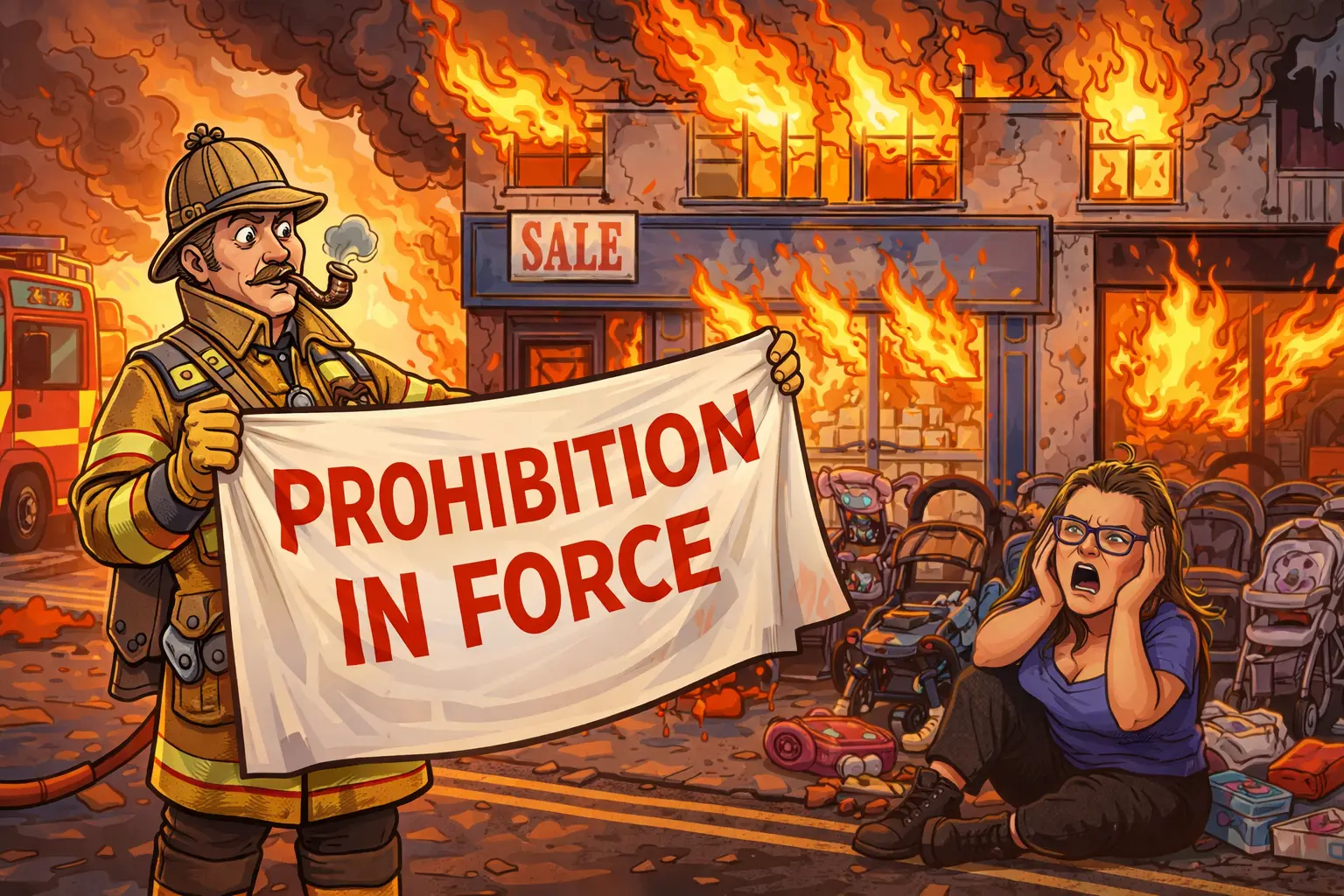
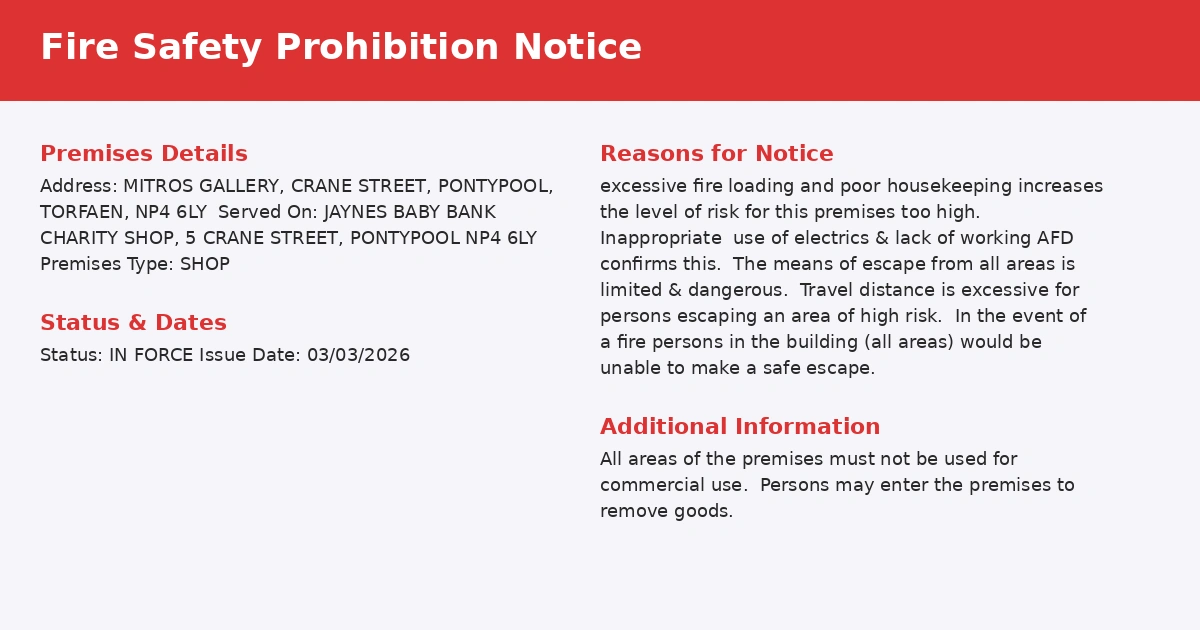
A review of the National Fire Chiefs Council (NFCC) Enforcement Register confirms that a Prohibition Notice is currently in force at: Jaynes Baby Bank Charity Shop, 5 Crane Street, Pontypool (NP4 6LY).
What the notice means
A Prohibition Notice is one of the most serious enforcement actions available to a Fire and Rescue Authority. It is issued where conditions present such a risk that the use of the premises must stop immediately.
In this case, the notice identifies:
- Excessive fire loading and poor housekeeping
- Unsafe electrical use and lack of working fire detection systems
- Dangerous and limited escape routes
- Travel distances too long for safe evacuation
The conclusion is clear:
In the event of a fire, occupants would be unable to escape safely.
As a result, all commercial use of the premises is prohibited. Entry is restricted solely to removing goods.
Practical consequences
This is not an advisory or minor compliance issue. The implications are significant:
- Immediate closure for trading
The premises cannot legally operate as a shop in any capacity. - Legal liability if breached
Continuing to trade or allowing public access could result in prosecution, fines, or further enforcement. - Reputational impact
A prohibition notice is public record and signals serious safety failings. - Operational disruption
Stock removal, remediation works, inspections, and re-approval are required before any reopening.
Contradiction with public activity
Despite the notice being in force from early March 2026, the following was publicly posted on Facebook on 25/03/2026:
“Running a bit late guys Dan’s cars in for MOT this am so only Pontypool open”
Source archive: View archived post
What this suggests
If accurate, this raises a direct inconsistency:
- The enforcement register states the premises must not be used for commercial purposes
- The post indicates the Pontypool location was open and operating
That gap matters. A prohibition notice is not optional, and it is not subject to interpretation. It is a legal restriction put in place to prevent risk to life.
The NFCC register is clear. The risks identified were severe enough to justify stopping all commercial use of the site. Until those risks are fully addressed and the notice lifted, any operation of the premises as a shop would be contrary to the enforcement action in place.
Sherlock


A new entry has been recorded on the National Fire Chiefs Council enforcement register relating to a premises in Pontypool.
Premises: Jayne’s Baby Bank Charity Shop
Address: Mitros Gallery, Crane Street, Pontypool, NP4 6LY
Notice type: Enforcement Notice
Status: In force
Issue date: 19/03/2026
Fire authority: South Wales Fire and Rescue Service
Reasons cited: A8, A13, A17
These “reason codes” are internal classifications used by fire authorities to indicate the nature of the fire safety concerns identified during inspection. While the register does not publicly define each code, their presence confirms that multiple compliance issues were identified that required formal enforcement action. An Enforcement Notice being “in force” means the responsible persons for the premises are legally required to address the specified fire safety failings within a set timeframe. Failure to comply can lead to further legal action.
This update confirms that the premises is currently subject to active fire safety enforcement measures.
Sherlock
More of this needs to be published far and wide to reach as many people as possible. Even people outside of the south Wales area.
Today from JBB:
The difficulty with your statement is that it attempts to normalise activity which the enforcement action explicitly prohibits.
A Prohibition Notice is not advisory, and it is not conditional on partial use of rooms, signage, or internal arrangements. It is a legal restriction that stops the premises being used where there is a serious risk to life. In this case, the NFCC enforcement register confirms such a notice is in force for the Pontypool site.
That has several straightforward implications:
The only permitted access, as outlined in the notice, is for the removal of goods. That is materially different from allowing customers in, conducting sales, or operating in any form that resembles a shop.
Your own description confirms:
Those are all indicators of continued use as a retail environment, which directly conflicts with the enforcement action in place.
The reference to electrics, landlords, or partial remediation is also not determinative. A prohibition remains active until it is formally lifted. It is not paused because some works have been undertaken or because responsibility is disputed.
The position is therefore simple:
If a Prohibition Notice is in force, the premises must not be used for trading. Any suggestion otherwise is not a matter of interpretation, it is a contradiction of the enforcement record.
Sherlock