
The short version
- Jayne’s Baby Bank has never filed accounts. Not one year, in five years.
- So we worked out what it cost to run, from documents anyone can check.
- Five of the nine shops have a rent we can prove. Three from signed leases. Two from her own posts.
- Every shop in Britain has a rateable value — the government’s own estimate of what it would rent for.
- She was paying about 72p of rent for every £1 of rateable value. Three of the four match almost exactly.
- That let us estimate the rents nobody has published.
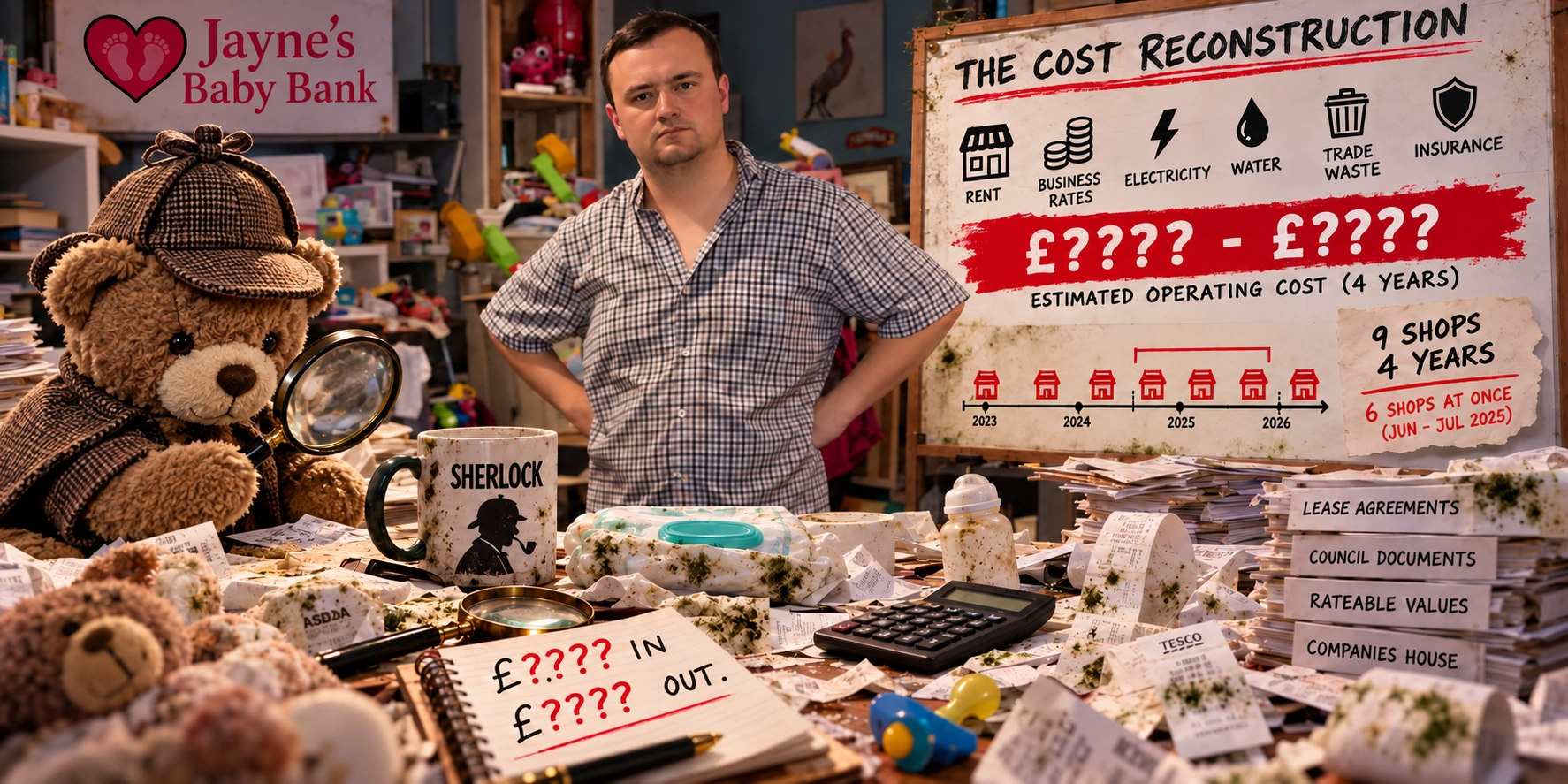
- In June and July 2025 she was running six shops at once, at around £6,620 a month.
- Over four years the bill comes to somewhere between £189,000 and £245,000.
- Updated 9 October. The Aberbargoed lease has since surfaced, so that shop is no longer an estimate: it adds £3,562.
- And she appears to be taking a 6,200 sq ft factory in Rogerstone at £30,000 a year. Five years of it would carry the total past £400,000.
- She says a charity or a CIC gets 80% off the rates. She was never a charity, and a CIC gets no such thing.
Updated, 9 October 2026
Two things have happened since this was published. The Aberbargoed lease surfaced, so the one figure we flagged as our weakest is now a document: it adds £3,562 and takes the four-year floor to £189,580. And she appears to be taking a 6,200 square foot factory in Rogerstone at £30,000 a year — four and a half times the largest rent on any lease of hers we have seen.
Five years of that building would carry the total past £400,000, on the most conservative reading available. The workings are in What it costs next.
There are no accounts. That is where this has to start.
Jayne’s Baby Bank was not a company until 7 November 2025, when Jaynesbabybank Registered CIC was incorporated at Companies House under number 16838920. Before that there was nothing to file, and nothing was filed. It has never been a registered charity — the Charity Commission refused the application in August 2023 — so there is no annual return either. The CIC’s first accounts are not yet due.
Five years. Up to six shops at a time. Three PayPal accounts, four JustGiving pages, a card machine in every till. Not one published figure for money in or money out.
She has asked the question herself. On 19 January 2026, defending the operation on camera:
“If we keep all the money, who pays for the donation centre, the water rates, the electricity, the rent, the business rates? Who pays for all of that? … Where do you think all our monies come from?”
Jaynesbabybank Registered – cic, 19 January 2026
It is a fair question. It also has an answer, and the answer does not depend on her producing anything. Leases are documents. Rating lists are public. Councils publish their tariffs. Court summonses get read out by accident on live video.
So we built the cost side from the outside in. This is how, and what it came to.
The four we can prove
Start with what is not arguable.
5 Crane Street, Pontypool. A lease dated 17 January 2023, three years fixed, running to 16 January 2026. £400 a month, security of tenure excluded.
We do not have to take anybody’s word for that one, because the whole parade was put up for auction while she was in it. On 13 December 2023 Acuitus offered Lot 30 — 1, 3 and 5 Crane Street together with 2, 2a, 4, 4a and 6 Commercial Street — as a single freehold. The catalogue carries a tenancy schedule, and her unit is on it:
- 1 Crane Street — tenant M. Philpot, trading as a vape shop.; term 5 years from 10 April 2015, holding over.; rent £8,000 a year.
- 3 Crane Street — tenant Phillips Opticians.; term 25 years from 22 August 1994, holding over.; rent £9,000 a year.
- 5 Crane Street — tenant J. RIDSALE, trading as Jayne’s Baby Bank.; term 3 years from 17 January 2023.; rent £4,800 a year.
- 2, 2a, 4 and 6 Commercial Street — Vacant.
£4,800 a year. £400 a month, to the penny, on a three-year term beginning 17 January 2023. Not our figure, not hers — a commercial sales document prepared for bidders, by an auction house, with a professional obligation to get it right. Note the name it gives the tenant, and note that 6 Commercial Street was still vacant in December 2023.
She has confirmed the same number herself. On 16 September 2026, setting out what each Pontypool unit cost her:
“P1 £400 per month and they wanted to increase it to do the work.
Jaynesbabybank Registered – cic, 16 September 2026
P2/3 landlord wanted £550 for down stairs and £900 upstairs. How much would you pay to rent these buildings.”
6 Commercial Street, Pontypool. Here we have the deed itself. The definitions table gives the rent as “£6,600.00 per annum for the Term”. That is £550 a month, exactly. Clause 5(a) tells her how to pay it:
“pay the Rent by equal monthly instalments in advance on the 27th day of every month together with any VAT, by standing order”
Lease, 6 Commercial Street, clause 5(a)
The term ran one year from 27 October 2024. It expired on 26 October 2025. She traded there for another 324 days.
13-15 The Market Place, Blackwood. One rent, covering a block that spans three shop numbers. She signed on 14 August 2023 and posted about it the same day:
“We just signed for our 4th shop! And we have been granted £1950 shop fit off the landlord and £1200 free rent!”
14 August 2023
Keys on the 16th. First day trading on the 18th. Two years later, after the shopping centre changed hands and the new landlord moved to put the rent up, she published the numbers:
“Blackwood landlord … has reduced his rent from 2000 to £1685. We were paying £1,200 and he dropped it to £1000 to keep us but then added vat = £1.200”
25 August 2025
And afterwards, watching it re-advertised: “Blackwood shop up for rent- just under 2000 a month — big jump from £999.” So £999 net, £1,200 with VAT, throughout. Not a cheap opening rate that crept up later. What she got at the start was an inducement: £1,950 towards fitting the shop out, and roughly one month rent free.
14 Pentrebane Street, Caerphilly. The weakest of the four, and we treat it that way. On 7 July 2025: “Caerphilly dropped his rent price twice for me. He was like, it’s £500 with VAT. I said, I can’t do the VAT. Too much. And he said, OK, I’ll lower it.” In August she mentions “600 a month”. Elsewhere she says she took it at half the Blackwood rent. We model £550 and flag it.
The pattern in those four numbers
Every commercial property in Britain carries a rateable value. The Valuation Office sets it, and publishes it free, online, for anyone to look up. It is not a tax. It is not a rent. It is the government’s own estimate of what that building would let for, over a year, on the open market.
Which makes it a yardstick that already exists. Put each rent we can prove against the official rateable value for the same building, and look at what comes out.
| Premises | Rent against rateable value | Rent | RV | Ratio | ||||
|---|---|---|---|---|---|---|---|---|
| 5 Crane Street, Pontypool | Rent £4,800 | RV £6,700 | Ratio 0.716 | |||||
| 13-15 The Market Place, Blackwood | Rent £14,400 | RV £20,000 | Ratio 0.720 | |||||
| 6 Commercial Street, Pontypool | Rent £6,600 | RV £9,100 | Ratio 0.725 | |||||
| 14 Pentrebane Street, Caerphilly | Rent £6,600 | RV £10,500 | Ratio 0.629 |
| Premises | Annual rent against rateable value | Rent ÷ RV |
|---|---|---|
| 5 Crane Street, Pontypool | £4,800 against £6,700 — signed lease | 0.716 |
| 13-15 The Market Place, Blackwood | £14,400 against £20,000 — her own post | 0.720 |
| 6 Commercial Street, Pontypool | £6,600 against £9,100 — signed lease | 0.725 |
| 14 Pentrebane Street, Caerphilly | £6,600 against £10,500 — her own statements | 0.629 |
Three of the four land within a single percentage point of each other. 0.716. 0.720. 0.725. Three different landlords, three different towns, two signed leases and one figure she posted on Facebook, and they agree to within a penny in the pound.
Caerphilly is the outlier at 0.629. It is also the one rent we are least sure of, which is either a coincidence or a sign the other three are doing what they look like they are doing.
That consistency is worth stopping on, because it is a finding on its own. She was taking shops at around 72% of open-market rateable value — consistently under the going rate. For two years the page ran a campaign telling landlords to wake up and drop their rents. On her own numbers, it had already worked.
Her neighbours, in the same building, on the same day
The auction catalogue lets us go further than a ratio, because it prints the floor areas alongside the rents. Three units in one parade, three tenants, one valuation date. Divide one by the other.
- 1 Crane Street, the vape shop — 869 sq ft at £8,000 a year — £9.21 per square foot.
- 3 Crane Street, Phillips Opticians — 1,657 sq ft at £9,000 a year — £5.43 per square foot.
- 5 Crane Street, Jayne’s Baby Bank — 1,980 sq ft at £4,800 a year — £2.42 per square foot.
She had the largest unit in the parade — 1,348 square feet of ground-floor retail, against the vape shop’s 539 — and she paid the lowest rent in the parade, in cash terms and per square foot. Less than half what the opticians next door were paying per foot. About a quarter of the vape shop.
And she knew it. Two and a half years after that catalogue was printed, on 27 July 2026, she set out the same two numbers herself — including the detail that the vape shop was holding over on an expired lease, which is exactly what the catalogue records:
“Blazing Vapourz, pays £8000 a year, Lease expired 2020 and they have been holding over the lease with no formal arrangement.
Jaynesbabybank Registered – cic, 27 July 2026
We paid £4,800 a year.”
An auction catalogue from December 2023 and a Facebook post from July 2026, produced by different people for unrelated purposes, agreeing on both figures and on the tenure. That is about as solid as a rent gets without a bank statement.
It also explains the ending. The parade went to auction, and by 2026 the landlord was Blazing Vapouz — the vape shop from number 1, managed through Premiere Properties, the agency she calls “prem props”. Her neighbour bought the building and became her landlord. Before the auction it had been Bournemouth Heights Estate.
Whatever else is arguable about this operation, the deal she negotiated at Crane Street was a good one, and it was not a charitable gift from the landlord: it was a commercial letting on a three-year term, recorded as such in a document prepared for investors.
The formula, in full
There is no cleverness here and nothing hidden. Anyone with a browser can reproduce every line of it. Set out in full, so it can be checked or contradicted:
- 1. Rent, where it is documented.
Take the figure from the lease or from her own published statement. No adjustment. - 2. Rent, where it is not.
estimated monthly rent = rateable value × 0.72 ÷ 12
The 0.72 is the mean of the three consistent observed ratios (0.716, 0.720, 0.725). Caerphilly’s 0.629 is excluded from the mean as an outlier and because that rent is itself the least certain of the four. - 3. Business rates, gross.
annual rates = rateable value × multiplier
Welsh multiplier by financial year: 0.535 (2023-24, frozen), 0.562 (2024-25, capped at 5%), 0.568 (2025-26, capped at 1%). From April 2026 Wales moved to three multipliers; shops take the retail rate of 0.350. - 4. Small business rates relief, applied correctly.
100% where rateable value is £6,000 or under. Between £6,001 and £12,000 it tapers:relief % = 100 − ((RV − 6000) ÷ 60) ÷ 100, which is roughly one percentage point lost per £60 of rateable value. Nothing above £12,000. Then the statutory cap: only two properties per business, per council. Where a council held more than two, relief is allocated to the two where it is worth most, and the remainder take retail relief of 40% instead. - 5. Electricity.
Anchored on a real invoice, not a tariff table. SSE Energy Solutions, site reference AGR1196766, 1–28 February 2026: 326.90 kWh, £199.40 including standing charge, £209.37 with VAT at 5%. That is the per-shop monthly figure. Warehouse units are modelled at £286, derived from the £6,000 electricity bill left at Blackwood over roughly 21 months. - 6. Water. £40 per site per month. An estimate.
- 7. Trade waste.
Caerphilly County Borough Council sells trade sacks at £92.00 per roll of 26 (£3.54 each) and trade recycling sacks at £46.00 per roll of 26 (£1.77 each). Modelled at two general and three recycling sacks a week per shop:((2 × 3.54) + (3 × 1.77)) × 52 ÷ 12 = £53.70a month per site. For a shop taking unsorted donations that is conservative. - 8. Insurance. Her own stated renewal figure of £196 a year for the lower bound. A market package for multi-site charity retail, at £1,000 per shop per year, for the upper.
Two deliberate choices sit inside that. Rates are shown with relief correctly applied rather than with the relief she says she had, because the correct position is the one the law produces. And every estimate is applied at the conservative end, so that where the model is wrong it is more likely to be wrong downwards.
Filling the gaps
Five shops have no published rent. Four of those five have a rateable value. Apply 0.72, and label the answer an estimate every time it appears.
| Premises | Rateable value | Estimated rent |
|---|---|---|
| Unit 35, Bowen Industrial Estate, Aberbargoed | £2,250 | No longer an estimate. The lease surfaced on 5 October: £238 a month, then £303. See below |
| 48 Worcester Street, Brynmawr | £2,225 | £134 a month |
| 68 Tredegar Street, Risca | £5,300 | £318 a month |
| Unit 5 Block D, Newbridge Road, Blackwood | £7,700 | £462 a month |
| Park Place, Risca | no entry traced | counted as nothing |
Park Place is the honest gap. We could not identify its entry on the rating list, and no rent for it has ever been published. Rather than invent one, we have costed a real shop at zero. Everything that follows is lower than the truth because of it.
Where the method is weakest, and what we did about it
A reconstruction is only as good as its worst assumption, so here is ours, set out so it can be attacked.
Why 0.72, and not some other number
The factor is not chosen, it is measured. Four premises have both a rent and an official rateable value. Divide one by the other and you get four ratios: 0.716, 0.720, 0.725 and 0.629.
The first three are the mean, and that mean is 0.720. We rounded to 0.72. The fourth — Caerphilly — is excluded, and we should say why rather than let it look convenient. Caerphilly is the one rent of the four that rests on no document at all: she gives it variously as “£500 with VAT”, “600 a month” and “half the rent” of Blackwood. We modelled £550 as the midpoint. If the true figure is £600 the ratio becomes 0.686; at £630 it would be 0.720 like the others. So the outlier may be an artefact of our own uncertainty about that rent, not evidence that the pattern breaks.
Including it anyway would move the factor from 0.72 to 0.698, and the whole four-year total by about £800. It makes almost no difference. We say so rather than pretend the choice was load-bearing.
The two premises where we were least confident
Aberbargoed and Brynmawr. When this report was published neither had a published rent, and neither is a high-street shop of the kind the factor was measured on. Aberbargoed is an industrial estate unit, a different letting market, and applying a retail-derived ratio to it was the weakest single step here. It is no longer an estimate: the lease is set out below. We have left the reasoning in place rather than quietly deleting it, so that the test can be seen working.
Because it was the weakest step, we went back through four years of her own posts and videos looking for anything that fixed either figure. We found that we had both tenancies wrong — and at Aberbargoed, that the question was not what the rent was but whether any of it was ever paid.
Aberbargoed: what she told followers, and what the landlord says
On 1 July 2023 she said it twice in one day. In a post: “We have also been lucky enought to have a year and half’s rent reduction at Aberbargoed because the landlord felt there was a need for the service in the area.” In a video the same day, more plainly: “very lucky in Aberbargoed that we’re not actually paying rent for the next year and a half in Aberbargoed.” Seven weeks later, on 19 August, a third time: “the landlord has granted us a free rent period.”
Taken at face value that would cut her costs, and we were prepared to model it at nil. Then we heard from the landlord.
He bought Unit 35 with her already in occupation, the lease in the name “Ceri-Anne trading as Jayne’s Baby Bank”. His account of the same period is the exact opposite of hers: “In the year before I finally got her evicted she didn’t pay a penny in rent to me, nor the Estate’s Service charge to the Estate, which I ended up paying.”
The court record settles which account to work from. Enforcement agents served notice at Unit 35 on 30 November 2023. Six months later, on 23 May 2024, a County Court Judgment was entered against “Ceri-Ann Ridsdale T/A Jayne’s Baby Bank” for £7,141, case 521MC287. It is recorded as unsatisfied. A landlord who has granted a rent-free period does not evict for arrears and then sue for them.
So the model charges Aberbargoed rent for every month of the occupancy, and the reason matters for how the whole report should be read. This is a model of what the operation cost, not of what she paid. Rent that fell due and went unpaid is still a cost of running the shop. It did not disappear; it turned into a judgment debt, and on the public register it is still outstanding.
Then the lease itself arrived
When this report was first published on 1 October, Aberbargoed was an estimate — £135 a month, calculated from the rateable value, and flagged here as the weakest single step in the method. Four days later we obtained the lease.
It is dated 22 June 2022, signed as a deed in the name “Ceri-Ann Ridsdale”, and it is backdated: a ten-year term running from 21 March 2022 to 20 March 2032. The rent is £4,160 a year plus VAT, payable quarterly in advance and reviewed upwards at years three, six and nine. A side letter signed the same day gives a concession — “the rent-free sum of £1,820 spread over the first two years” — which works out at £238 a month in the first year and £303 in the second.
That settles an argument three ways at once, and it is worth being plain about which way each one falls.
- Our estimate was too low. We said £135. The lease says £238, then £303.
- Her figure was too high. On 3 October she said “Aberbargoed £400? paid in full”. The headline rent including VAT is £416 a month — so £400 is roughly what the lease says before the concession, but it is not what she was actually billed.
- “Paid in full” does not survive. The judgment creditor is the landlord of that unit, and he says that in the year before he evicted her she “didn’t pay a penny in rent”.
Replacing the estimate with the lease adds £2,132 to the four-year total. The lease also proves she held the unit from March 2022, six months before this report’s window opens, which is a further £1,430 of rent. We have added that as a separate line rather than folding it in: the lease evidences the rent for those six months, but nothing evidences the shop trading, so we claim no electricity, water or waste for them.
It is also a measure of how conservative the figures are even now. Across the whole tenancy the lease puts the rent at a little over £5,500 before VAT. The judgment for that one unit is £7,141 — and that is before the estate service charge the landlord says he ended up paying himself. We have not raised the figure to meet the judgment, because a judgment sum includes costs and interest that cannot be separated out. The two are left side by side so the gap is visible.
The £7,141 is counted in this investigation’s schedule of debts, not added to the running-cost total above, because adding it would count the same Aberbargoed rent twice. Of the judgment she said publicly that it was “not even my name”.
Brynmawr ran seven months, not eleven
We had it opening in August 2023. It did not. She was still advertising for staff on 3 December 2023 — and on 5 December was explicit that she had not committed: “I’m looking at a shop in Brynmawr (babybank) I need at least 2 volunteers managers and 6-10 volunteers before I sign for it.” She signed on the 7th: “Signed for our shop in Brynmawr this morning.” It closed on 12 July 2024 — “Brynmawr last day today as we are closing it.”
The corroboration is in the silence. Across the whole corpus there is not one mention of a Brynmawr shop between August and November 2023, the months we had been charging rent for. From December 2023 there are more than twenty a month. Four months came off the front and one went back on the end — a net three months, worth £401.
What the signing-day post does give us is a direction, not an amount. The new landlord, she wrote, was “cheaper than both and allowing us to use a storage area for free — no brainer”. Cheaper than the two units she had just lost. It tells us Brynmawr was at the bottom of her range. It does not tell us what she paid, so we have not pretended otherwise.
Why we did not simply round both up
Before the lease surfaced it was put to us that both should be set higher — £300 a month “to be safe”. We declined, and the reason was arithmetic. £300 a month is £3,600 a year against a rateable value of £2,250: a rent 1.6 times the rateable value, when every rent she was known to have negotiated came in at 0.63 to 0.73 of it.
The lease has since settled it, and it is worth recording how the guess would have fared. The second-year rent is £303 — within three pounds of the £300 that was suggested, and well above the £135 we published. On this one, the instinct to round up was closer than the method was. We still would not have printed it, because “it felt about right” is not a source and the next guess might land the other way. But the method was wrong here, and saying so is the price of using it.
Raising an estimate you cannot support is not caution. It is the one thing that would turn a conservative figure into an arguable one, in a report whose whole claim is that its total is a floor. Correcting those two tenancies moved the total down by about £1,300 at Brynmawr, which turned out to be four months shorter than we had it, and then up by £3,562 at Aberbargoed once the lease arrived. Both corrections are published. That is the test of whether a floor is really a floor — and the £7,141 judgment sitting over one unit’s £5,500 of contracted rent is the test of how far below the truth a floor can be.
What happens if we are wrong
Three assumptions do real work in this report. Here is what the four-year total becomes if each is pushed the other way.
- Brynmawr rent — modelled at £134 a month from the rateable value, Aberbargoed now being documented. Push it to £300 and the total goes £188,150 → £189,482, up 0.7%.
- Business rates relief — modelled with relief correctly applied, £29,141. Assume no relief at all, £69,009, and the total goes £188,150 → £228,018, up 21.2%.
- Insurance — modelled at her own figure of £196 a year. Use a market rate for six sites and the total goes £188,150 → £204,100, up 8.5%.
- All three together — £188,150 → £245,299, up 30.4%.
The £245,000 upper bound given earlier in this report is the rates and insurance assumptions pushed up but the rents left alone, because those two rest on published rules and market rates while the rent uplift rests on nothing. Push all three and you reach about £245,000.
Note which way every one of those runs. There is no assumption in this report that, if wrong, makes the figure smaller. That is deliberate: where we had a choice, we took the lower number, and the upper bound of the range is what you get by taking the higher one every time.
What would overturn any of it
- A lease or rent demand for Brynmawr. It would replace the last RV-calibrated estimate in this report with a fact. The Aberbargoed one, which stood here when we published, reached us on 5 October and is now set out above.
- A rates demand or relief decision for the Pontypool or Blackwood premises. Torfaen has refused to disclose its relief position; a demand notice would settle the largest single uncertainty in the report.
- An insurance schedule. £196 a year is what she says she paid. A policy document would show what was actually covered, and at how many sites.
- Any set of accounts. None has ever been filed. The CIC’s first are due by 7 August 2027, and they will be the first published figures in six years.
Send us any of those and we will republish with the real number in place of ours, whichever direction it moves.
Nine shops, four years
Rent is only half of it. The other half is how many were running at once, and for how long. Those dates come from her own posts, from council inspection records, and from the notices landlords taped to the windows on the way out.
| Premises | Sept 2022 → Sept 2026 | Rent pcm | |||
|---|---|---|---|---|---|
| Park Place, Risca | Rent estimated | ||||
| Unit 35, Aberbargoed | Rent £303 | ||||
| 5 Crane Street, Pontypool | Rent £400 | ||||
| 48 Worcester St, Brynmawr | Rent estimated | ||||
| 13-15 Market Place, Blackwood | Rent £1,200 | ||||
| 68 Tredegar St, Risca | Rent estimated | ||||
| Newbridge Rd donation centre | Rent estimated | ||||
| 6 Commercial Street, Pontypool | Rent £550 | ||||
| 14 Pentrebane St, Caerphilly | Rent £550 |
The two Pontypool shops together — £400 and £550, so £950 a month — ran side by side for 22 months. That is the pairing most people know about. What the chart shows is that for almost all of it, they were never more than about a quarter of the rent bill. Risca was running. The Blackwood donation centre was running. From June 2025, so was Caerphilly.
The eighty per cent
Rent is the biggest line, but it is not the only one. Business rates are the next, and this is where her public position stops matching the law.
On 1 February 2026 she explained why the rates did not worry her:
“There is a post out saying that I owe something like about £17,000 in business rates or something. I haven’t really read it … You get 80% discount if you’re a charity or a CIC, and then you get 20% discretionary. So you technically get under it … It’s a bit like a peppercorn payment.”
Jaynesbabybank Registered – cic, 1 February 2026
Three things are wrong with that, and they stack.
She was not a charity. The mandatory 80% discount comes from the Local Government Finance Act 1988, and it requires the ratepayer to be a charity, or to hold the property as a trustee for one. Her application was refused in August 2023.
A CIC is not a charity. It gets no mandatory relief at all. A community interest company can apply for discretionary relief under section 47, which a council may grant, or may refuse. And there was no CIC until November 2025 — by which point the Commercial Street lease had already expired.
And small business rates relief in Wales is capped at two properties per business, per council. This is the part nobody mentions. Within Caerphilly County Borough alone she occupied six premises at various points: Aberbargoed, Blackwood Market Place, the Newbridge Road donation centre, Park Place Risca, Tredegar Street Risca and Pentrebane Street Caerphilly. Two of them could attract relief. The rest were rateable in full.
Nor is any of this news to her. On 29 May 2025, complaining about Blackwood High Street, she quoted the figure herself:
“plus the raiseable value is £20,000 on Blackwood High Street, that’s a lot, that’s a lot that is, considering shops are closing one after another”
Jaynesbabybank Registered – cic, 29 May 2025
“Raiseable” for rateable, and £20,000 is the Valuation Office’s figure to the pound.
Run the whole footprint through the rating list at the Welsh multiplier and the four-year rates bill looks like this.
| Scenario | Rates across 49 months |
|---|---|
| No relief at all | £69,009 |
| Relief correctly applied | £29,141 |
| Her position — 80% plus 20% discretionary | £0 |
We asked. Torfaen would not say.
There is one way to settle whether relief was ever granted, which is to ask the billing authority. We did, under the Freedom of Information Act, on 18 September 2025: had charitable relief been applied at 5 Crane Street, had any discretionary relief been granted, and from what dates?
Torfaen refused on 24 September, citing section 41 — information provided in confidence. We asked for an internal review. On 6 October 2025 the Head of Legal Services upheld the refusal, but on a different ground: section 40(2), personal data. Her reasoning contains this:
“The requested information is personal data as it relates to an individual as the entity known as Jaynes Baby Bank is not a registered company.”
Torfaen County Borough Council, FOI internal review 25/418, 6 October 2025
That is the billing authority, in writing, confirming that the rates account is held by a private individual because there is no company behind the name. Which is precisely why the mandatory 80% could not apply.
The review also went out with an internal drafting note still in it, left in the body of the letter by mistake:
“Should we mention:- not giving them anything regarding relief from here though.. only RV”
Torfaen County Borough Council, FOI internal review 25/418 — editorial comment left in the released document
So the relief position at Pontypool remains undisclosed, which is why this report models it rather than states it, and why the answer is a range.
But Caerphilly’s relief is not a secret, because she published it
Torfaen would not say. She said. On 17 May 2025, in a single line on the page:
“Just had confirmation of a £3010.40 discount from Caerphilly Council for Risca Shop”
Jaynesbabybank Registered – cic, 17 May 2025
Put that figure against the rating list. 68 Tredegar Street has a rateable value of £5,300. The Welsh multiplier for 2025-26 is 0.568.
£5,300 × 0.568 = £3,010.40
To the penny.
That is not a discount off the bill. That is the bill. The whole of it, written off — 100% relief at Risca.
Which is exactly what the law produces, and exactly what this report’s model produces, without either of us knowing the other’s answer. A rateable value of £5,300 is below the £6,000 ceiling, so small business rates relief covers it in full. No charitable status required, and none claimed by the council. The relief she was entitled to, she got.
There was an earlier award too. On 29 July 2024: “We have just recieved another £3,101.16 discount off one of the councils — thank you to the idiot who complained to the councils to make sure we were being charged exactly what we should be!! Because obviously we were paying to much!!!” She does not say which council or which shop, and the figure does not match any single premises’ annual bill cleanly, so we take it no further than recording it.
Two things follow from the Risca award, and they pull in opposite directions.
It is a point in her favour on the arithmetic: where relief was due, it was given, and this report’s lower bound of £29,141 — the “relief correctly applied” column — is the right one to use, not the gross figure.
But it also sharpens the question Torfaen will not answer. Relief at Risca came automatically from the size of the shop. It had nothing to do with being a charity, which she is not, and nothing to do with the 80% she keeps describing. The premises where the answer actually matters are the big ones — Blackwood at a £20,000 rateable value, where no small business relief was available at all, and the Pontypool shops where the two-property cap bites. On those, the council has declined to say.
What is not in dispute
Two demands are on the record, and we have both.
The first is a magistrates’ court summons issued on Torfaen’s application for unpaid business rates. It sets out the rates due, the authority’s summons costs and the magistrates’ summons costs, and gives a total amount due of £1,105.00, with a further £30.00 to be added to the balance if it is not paid in full. It is signed by Jayson Lewis, Clerk to the Justices. She displayed it on camera herself.
The second is what followed: a liability order. The council’s covering letter, addressed to “Mrs Carrie Ann…”, explains that the court has granted it, that the next steps “could include taking control of” goods, and sets out four options with a further £70.00 attached. A liability order is the enforcement step that follows a summons: it is the court confirming the debt is owed and authorising recovery.
She filmed that letter too, and posted it with a caption across the screen:
“Jayne’s Baby Bank Wins Again!”
caption on her own video of the liability order
Her position, on 8 September 2026, was that “none of these landlords/electiciality companies/councils have ever taken me to court for non payment of rent, business rates, electricity”. A summons and a liability order are both court process, and both are for business rates.
There is also a Caerphilly County Borough Council non-domestic rates demand dated 13 March 2026 for the Newbridge Road unit, which she published herself to prove she was legitimate.
What it comes to
Rent, rates, electricity, water, trade waste, insurance. Month by month, September 2022 to September 2026.
| Quarter | Rent, rates and running costs | Shops | Total | ||||
|---|---|---|---|---|---|---|---|
| Q3 2022 (1 mth) | Shops 2 | Total £937 | |||||
| Q4 2022 | Shops 2 | Total £2,812 | |||||
| Q1 2023 | Shops 3 | Total £5,091 | |||||
| Q2 2023 | Shops 3 | Total £5,220 | |||||
| Q3 2023 | Shops 4 | Total £10,009 | |||||
| Q4 2023 | Shops 5 | Total £12,740 | |||||
| Q1 2024 | Shops 4 | Total £12,620 | |||||
| Q2 2024 | Shops 4 | Total £12,760 | |||||
| Q3 2024 | Shops 5 | Total £13,595 | |||||
| Q4 2024 | Shops 5 | Total £16,378 | |||||
| Q1 2025 | Shops 5 | Total £16,378 | |||||
| Q2 2025 | Shops 6 | Total £17,558 | |||||
| Q3 2025 | Shops 6 | Total £15,719 | |||||
| Q4 2025 | Shops 5 | Total £13,648 | |||||
| Q1 2026 | Shops 5 | Total £13,648 | |||||
| Q2 2026 | Shops 5 | Total £11,850 | |||||
| Q3 2026 | Shops 3 | Total £7,187 |
The peak is June and July 2025. Six shops live. Around £6,620 a month.
Across the whole period it lands in a range, not on a number, and the range is honest rather than cautious. The low end assumes the rates relief she was actually entitled to, and takes her own insurance figure of £196 a year at face value. The high end assumes no relief at all, and insurance at what a six-site charity retail operation would really be quoted.
| Lower | Upper | |
|---|---|---|
| Rent | £95,505 | £95,505 |
| Business rates | £29,141 (relief applied) | £69,009 (no relief) |
| Electricity and water | £53,342 | £53,342 |
| Trade waste | £10,792 | £10,792 |
| Insurance | £800 (her figure) | £16,750 (market rate) |
| Total | ~£189,000 | ~£245,000 |
She has given her own figure, without meaning to. On 11 August 2026, complaining about Cwmbran town centre: “what business can afford to pay out approx 50k a year in rates and rents.” For 2025 our model gives £59,401 before relief and £43,398 after. Her number sits between the two. On that, at least, she was describing her own books accurately.
Set against all of it, the public funding we can independently confirm across four years is £1,000 — a Pontypool Community Council grant awarded in November 2024. The total she has publicly claimed to have received is at least £44,928.
Although on 19 January 2026, in the same broadcast where she asked who pays for it all, she also said this:
“we’ve only just registered as a CIC and we’ve only ever had a thousand pound grant”
Jaynesbabybank Registered – cic, 19 January 2026
Which matches the verified figure exactly, and contradicts every other funding claim she has made.
What it costs next
Everything above is history. On 7 October 2026 photographs showed what looks like a move into Principality House, Western Valley Road, Rogerstone — a former medical-supplies factory of 6,200 square feet, advertised by NP Linnells at £30,000 a year on a full repairing and insuring lease. Newport City Council has since opened a planning enforcement case, reference E26/0329, into a proposed “change of use to charity shop and childrens activity centre” at the building.
£30,000 a year is four and a half times the largest rent on any lease of hers we have seen, and nearly double all three documented leases added together. Of a unit at roughly this scale she said, in February 2026:
“We’re looking at two warehouses. We’re looking at 30 to 40 thousand a year, which is astronomical out of fundraising.”
Jaynesbabybank Registered – cic, 5 February 2026
On 15 September she described the terms: “5 years lease but no renewal as they have plans!” So here is what five years of that building would cost, on the same method used for every shop above — the advertised rent, the rating list, the building’s own energy certificate and published council tariffs.
| Cost, a year | Low | High |
|---|---|---|
| Rent, exclusive of VAT | £30,000 | £30,000 |
| Business rates | £3,230 | £4,970 |
| Electricity | £4,980 | £36,700 |
| Trade waste | £1,600 | £3,000 |
| Water | £500 | £1,500 |
| Insurance | £1,500 | £4,500 |
| A year, before VAT | £41,810 | £80,670 |
| A year, including VAT | £49,306 | £95,150 |
How each line is reached: rent is the advertised figure. Rates are a rateable value of £9,900 times the 0.502 multiplier, with the low end assuming the small business taper. Electricity comes from the building’s own energy certificate — the low end is lights only, the high end heats all 648 square metres. Waste is a benchmarked tariff and water a non-household supply with usage unknown. Insurance assumes, as the lease requires, that the tenant repays the building premium. VAT is 20%, and insurance premium tax 12%.
The electricity line is the honest weakness, and it is doing almost all of the work in that spread. Nobody can narrow it without a meter reading, so we publish the range rather than a midpoint dressed up as a finding.
VAT belongs in the figure, not in a footnote. It is only reclaimable by a VAT-registered business making taxable supplies, and there is no evidence this one is registered. If it is not, that £7,500 to £14,500 a year is money out that never comes back. Nor can the charity argument reach it: the reduced 5% rate on electricity needs qualifying charitable non-business use, and a CIC is not a charity — the same reason the 80% rates relief fails.
Where that takes the total
| Excluding VAT | Including VAT | |
|---|---|---|
| Five years at Rogerstone, low | £209,050 | £246,530 |
| Five years at Rogerstone, high | £403,350 | £475,750 |
| Added to the £189,580 already spent, low | £398,630 | £436,110 |
| Added to it, midpoint | £495,780 | £550,720 |
| Added to it, high | £592,930 | £665,330 |
Four cautions, because this is a projection and not a reconstruction. No lease has been seen — the five-year term is her own description. The building has not been confirmed to us by the agents, who said only that they are “looking into the matter”. The figures exclude the Newbridge Road donation centre and anything else running alongside. And they exclude repairs entirely, which on a full repairing and insuring lease fall on the tenant.
Every one of those four pushes the number up.
What we have left out
A shop costs more to run than rent, rates and power. Here is everything we know she was paying for, or was contractually liable for, that is not in the figures above. All of it pushes the real number up.
Costs we can put a figure on, but have not counted
- Fitting out a shop — about £1,000 each. Her own estimate, November 2022: “we need to spend at least £1,000 on racking before we get in there”. Nine premises.
- Deposits and bonds — £400 to £500 a time, plus a month up front. Also hers: “every shop that we go into, we’re going to need at least say £500 deposit. They usually like a month up front”. She confirms a £400 bond at Crane Street, which she told the landlord to keep.
- Volunteer allowances. Paid in stock at £13 an hour or £20 a day. On 9 April 2025 she published what that actually costs the operation, at a 75% discount: a £20 allowance costs £5, £25 costs £6.25, £40 costs £10, £50 costs £12.50. With “over 30 volunteers split between 4 sites” recorded at a 2023 inspection, this is not a rounding error.
- Waste disposal of damaged stock — £450. One instance, June 2026, for about £2,000 of water-damaged goods at Pontypool.
- The Insurance Rent. Clause 5(b) of the Commercial Street lease requires the tenant to reimburse the landlord’s buildings premium on demand, and clause 4 lists it as a sum due alongside the rent. No demand has been published, so we have modelled nothing — but it was owed. The same lease charges interest on arrears at 4% above the Royal Bank of Scotland base rate.
Smaller costs we can now put a figure on
A later sweep of her posts and broadcasts turned up hard numbers for most of the lines we had written off as unquantifiable. None is large on its own. Together they are the difference between a shop and a stall.
- Card terminals, £400 — one-off, 2025. “bought the card machines which cost the baby bank an additional £400. Plus wifi units”
- CCTV install, £200–£300 per shop — “that would be £200-£300 for us out of our fundraising”
- Racking, £40 actually spent — one-off, 2022. “This cost us £40. I took it out of our money this week”
- Racking, £1,000 her estimate per new shop — “we need to spend at least £1,000 on racking before we get in there”
- Opening a shop, £2,000 and up — one-off. A £500 deposit, a month up front and racking — her own breakdown.
- Volunteer DBS checks, £12 each a year — “they are £12 a year… we will reimburse you” — against “over 30 volunteers” in 2023.
- Small society lottery licence, £20 a year — “It’s £20, I think, a year… Got to pay every year” — the statutory renewal fee exactly.
- Accountant, £1,000 a year — prospective. Her own estimate, February 2026, for an audited set of accounts.
- Lease renewal fees, £60 or £40 — per renewal, from the Crane Street lease terms, plus £1.50 a page for copies.
- Lockable volunteer lockers, £40 — one-off, 2022. “fab for 40. I think they retail at 70”
- Car boot pitch, £3–£5 — per pitch. “We cover the costs of the pitch”
And the costs she avoided
An honest cost sheet records the noughts as well. Several lines that would normally bite a retailer did not bite here, and she says why.
- Gas: nil. “business rates, electric, no gas sorry, water rates” (19 January 2026). We have found no gas account at any premises.
- Food hygiene and health and safety training: nil. “FREE HEALTH AND SAFTY TRAINING AND FOOD HYGIENE TRAINING PROVIDED BY CAERPHILLY COUNCIL AND TORFEAN COUNCIL”.
- Food business registration: nil. Statutory registration is free. The Risca registration of 24 February 2024 is on the council record.
- PAT testing: nil. “My father was a qualified electrician and him and Daniel have both done the pat testing course” — done in-house.
- Heating plant: nil. Heaters were donated or moved between shops. “No charge to the baby bank.”
- Waste carrier registration: not held. Asked about an upper-tier licence she answered “I’ve outsourced this… They will carry their own agreement.” No contract has been evidenced.
- Fundraising Regulator levy: nil. The Regulator confirmed in October 2024 that the organisation is not registered with it.
Costs that are certain, but we still have no figure for
- Repairs, decorating and maintenance. Not optional and not the landlord’s. Both leases are full repairing and insuring. At Commercial Street clause 5(g) puts the building in repair on her, 5(j) decorating inside and out, 5(k) replacing the floor coverings before the end of the term, and 5(h) keeping the drains clear.
- CCTV and alarms. Not speculative — a screenshot she posted on 16 April 2025 shows a monitoring app with Pontypool CCTV and Blackwood CCTV, two cameras each. Monitored systems carry a monthly charge.
- Fire safety servicing. Extinguishers, alarms and emergency lighting need annual certification. Conspicuous, given an independent Fire Risk Assessment in September 2025 graded the risk to life “Substantial” and a Prohibition Notice followed in March 2026.
- Card machine fees. The shops went cashless in July 2024 — “all cashier tills have been removed” — so every sale from then on carried a processing fee.
- Licences. A music licence is required to play music in a shop. A small society lottery was registered at the Aberbargoed address in June 2023. Food business registration applied at several sites.
- Telephone, broadband and wifi, at up to six premises at once.
- Pest control. Pigeons were a documented problem at Pontypool and Blackwood.
- Cleaning and consumables — carrier bags, labels, tape, hangers.
- Vehicles, fuel, stock purchase, skips, bank and PayPal fees, signage, professional fees. A van was run for collections; nappies and formula were bought in; an accountant was described doing the books.
- Park Place, Risca — an entire shop, costed at nothing, because no rent was ever published and we could not identify its rating list entry.
- The upper floors at Commercial Street (“P3”), quoted at both £900 and £400, never signed, filled with donated stock anyway.
- An undisclosed storage location, which on 26 May 2026 she called somewhere “we haven’t… disclosed that problem to anybody yet”.
- The 2026 revaluation, which raised most of these rateable values from 1 April 2026.
The one line that really is nil
Gas. On 19 January 2026, listing what she pays for, she said it herself: “business rates, electric, no gas sorry, water rates”. We have found no gas account at any premises. It is the only whole cost line in this report we are confident was zero across all four years — the other zero, the Aberbargoed rent, covers one unit for five months.
Everything else above makes the real number bigger. £189,000 is the floor, not the ceiling — and it is a floor with at least a dozen known costs sitting underneath it, uncounted.
What these words mean
- Rateable value — the Valuation Office’s estimate of what a property would rent for in a year. Not the rent. Not the rates bill. The number the bill is worked out from.
- Multiplier — what you multiply the rateable value by to get the bill. In Wales it was 0.568 in 2025-26.
- Mandatory charitable relief — an automatic 80% discount on business rates. Only registered charities get it.
- Discretionary relief — a further discount a council may give. It does not have to.
- Small business rates relief — a discount for small premises. 100% below £6,000 of rateable value, tapering to nothing at £12,000. Limited to two properties per business in each council area.
- CIC — community interest company. A limited company with an asset lock. Not a charity.
- Hereditament — one property, as the rating list records it. Two shops knocked together are still two hereditaments until the Valuation Office says otherwise.
One date to keep
JAYNE’S BABY BANK C.I.C., company number 16838920, was incorporated on 7 November 2025 as a private company limited by guarantee. Its registered office is Unit 5 Block D, Newbridge Road Industrial Estate, Pontllanfraith — the donation centre, and the one unit still held.
Its first accounts are made up to 30 November 2026 and are due at Companies House by 7 August 2027. Its first confirmation statement is due by 20 November 2026.
A community interest company is not a charity, but it is a limited company with an asset lock, and it has to file. When those accounts appear they will be the first published financial statement this operation has produced in six years. Everything above is what the public record says the outgoings were. That filing is the first chance anyone has had to compare it against her own figures.
About this reconstruction
Everything here is drawn from public records and from statements the operator published herself. No confidential, leaked or unlawfully obtained material has been used. The sources are: the Valuation Office rating list, which is published free online for every commercial property in Britain; Companies House; published Welsh Government and Business Wales guidance and the Local Government Finance Act 1988; council fees and charges published by Caerphilly County Borough Council; notices displayed publicly in shop windows; two commercial leases; an energy invoice and council correspondence which the operator herself held up to camera and broadcast; and several thousand of her own public posts and livestreams.
We are not lawyers, accountants or rating surveyors, and nothing here is advice. Errors of fact will be corrected on the record. If the operator, any landlord, any council or any other party believes a figure here is wrong, we will publish the correction alongside the evidence for it.
Sources
Everything below is public. Where a source is a document rather than a web page, it is in our document archive.
- Valuation Office rating list — rateable values and effective dates for all nine premises, retrieved 19 September 2026. Find a business rates valuation
- StatsWales, historic non-domestic rates multipliers — the 0.535, 0.562 and 0.568 figures used here. StatsWales dataset
- Business Wales guidance on small business rates relief, charitable rates relief, hardship and discretionary relief and the multipliers
- Local Government Finance Act 1988, sections 43, 47 and 49. legislation.gov.uk
- Companies House — JAYNE’S BABY BANK C.I.C., company number 16838920: incorporated 7 November 2025, and first accounts due 7 August 2027. Companies House record
- Caerphilly County Borough Council published commercial waste charges. Commercial waste
- Acuitus auction catalogue, Lot 30, sale of 13 December 2023 — the tenancy schedule for 1, 3 and 5 Crane Street and 2, 2a, 4, 4a and 6 Commercial Street, giving tenants, terms, floor areas and rents. In our document archive
- Torfaen County Borough Council, Freedom of Information internal review 25/418, 6 October 2025 — the refusal to disclose the rate relief position at 5 Crane Street. In our document archive
- Magistrates’ court summons for £1,105.00 in unpaid business rates on Torfaen CBC’s application, and the liability order that followed. Background: Real name, real fines
- Lease, 6 Commercial Street — definitions table and clauses 1, 4, 5(a), 5(b), 8, 13 and 14; HM Land Registry title CYM339453. Extracts published with “Not Even My Name”
- 5 Crane Street — lease of 17 January 2023 and the landlord’s possession notice of 15 August 2026. See “The end of the road”
- SSE Energy Solutions invoice, 1–28 February 2026, site reference AGR1196766, and the warrant notice of 13 March 2026. See “Lights out on Commercial Street”
- Landlords’ notices posted at 68 Tredegar Street (8 June 2026), 5 Crane Street (15 August 2026) and 6 Commercial Street (15 September 2026)
- The operator’s own posts and broadcasts, dated in the text throughout. Indexed in our document archive
Carrie-Anne Ridsdale, also known publicly as Jayne Price, has a standing right of reply, and it is open now. Every figure in this report is published with its source and its working, so that any of them can be contradicted with a document. If one is wrong, send us the lease, the bill, the demand or the statement that shows it, through our contact page, and we will correct it on the record. Any response is published in full and unedited, and the offer does not expire.
“The Welsh Charity Shop Hoax: Exposed!” is a public interest project examining the public claims and activities of Jayne’s Baby Bank. Factual statements are supported by evidence where available, and opinions are identified as such. Nothing on this site should be interpreted as a legal finding or legal advice.
…Sherlock